What Is a HUD in Counter-Strike 2?
HUD stands for Heads-Up Display - the layer of information that appears directly on your screen without pulling you away from the action.
The concept didn’t originate in gaming at all. HUDs were first used in aviation, military targeting systems, and later in modern cars to give pilots and drivers instant access to critical data without looking away from their surroundings. Games borrowed this idea for the same reason: to keep players informed without slowing them down.

History of HUDs in Video Games
The first HUDs in games were extremely basic - simple numbers, icons, or static bars in early arcade titles. Once the 90s arrived and games became more complex, HUDs evolved quickly. They started showing more detailed player stats, animated elements, directional indicators, and dynamic information.
A great early example is Doom (1993), often called the father of modern first-person shooters. DOOM didn’t just show your health and ammo - it displayed the player’s face reacting to damage, power-ups, and low-HP situations. Some people point to Wolfenstein 3D (1992), but that was more of a proto; DOOM set the real standard for how information could be integrated into a first-person experience.
Over time, HUDs became richer, cleaner, and more adaptive. Once competitive games like Counter-Strike appeared, HUD design shifted toward clarity and speed - giving players exactly what they need and nothing more.
Counter-Strike 2 continues this evolution on Source 2. Its HUD is more minimalistic, more polished, and far more configurable than older versions of the game. Instead of a cluster of static icons, CS2 uses a cleaner visual style and gives players multiple options for sizing, coloring, and simplifying the display.
CS2 HUD and Radar Elements Explained
When you play Counter-Strike 2, the HUD quietly feeds you a constant stream of useful information. Most of it becomes second nature, but every element exists for a reason. Here’s a clear breakdown of the key parts of the CS2 HUD and why each one matters in real gameplay.

Radar Overview and Tactical Importance
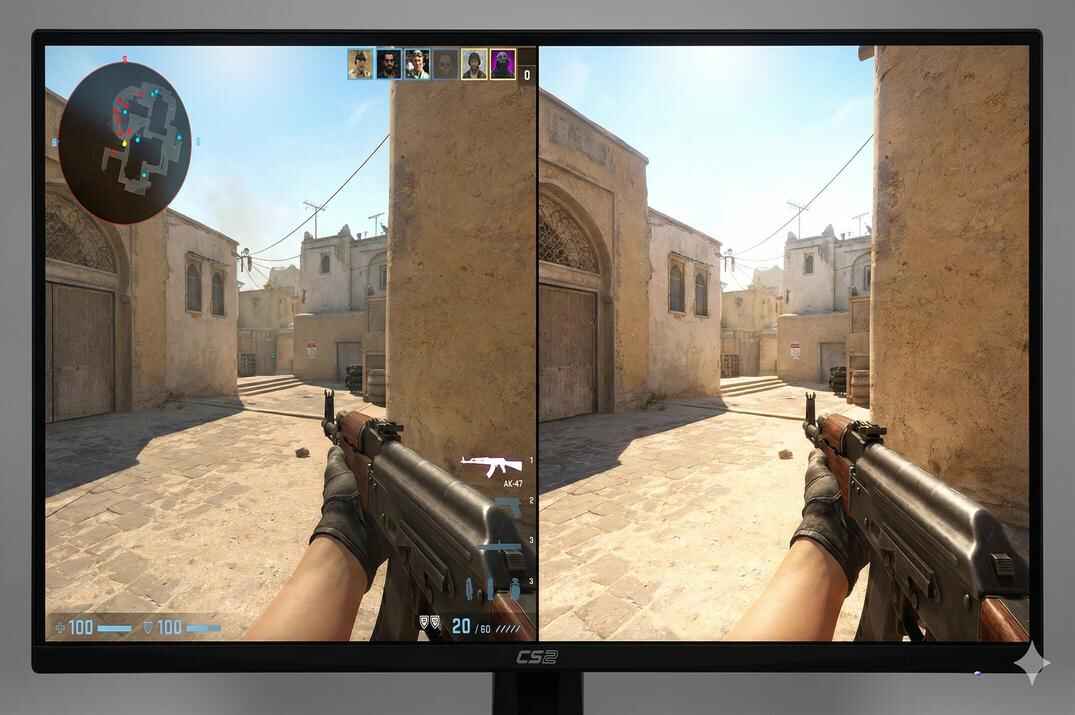
The radar is your quick snapshot of the battlefield. For newer players it helps with basic orientation - knowing where you are, where teammates are positioned, and where fights are happening. For experienced players, the radar becomes a tactical tool: spotting rotations, identifying gaps in control, and seeing teammate positions without needing constant voice communication. It’s especially helpful when moving through smoke or when you need to quickly verify map presence without shifting your focus away from your crosshair.
Health & Ammo Indicators
These sit at the bottom of the screen and are arguably the most critical HUD elements. Low health changes how you take duels. Limited ammo affects how aggressively you can hold angles. A quick glance at these values can decide if you commit to a fight, fall back for safety, or play for trades. Even high-level players rely on these indicators to manage risk during each round.
Round Timer and Player Icons
Displayed at the top of the screen, these two elements give you situational awareness that directly shapes your decisions. The round timer dictates your pacing - when to push, when to rotate, when to fake, when to save. Player icons tell you who’s still alive and who’s out of the round. Veteran players often don’t need avatars and switch them to simple numbers for a cleaner HUD and slightly better performance. But regardless of the format, knowing the live count is essential for planning your next move.
Weapon & Utility Panel
Shown in the bottom-right corner, these icons aren’t as critical for experienced players - most know exactly what they’re carrying. Still, in hectic situations it’s easy to forget if you have the right grenade or how many flashes are left. This small reminder helps avoid misplays during clutch moments.
Economy Display (Money HUD)
Your money is displayed in the bottom-left corner. While CS2’s economy is a huge part of team strategy, you shouldn’t be obsessing over your cash in the middle of a duel. But between fights or during rotations, checking your money can help you prepare the next round’s buy early - and those extra seconds of planning often matter more than people think.
Why Players Hide the HUD in CS2
There are quite a few situations where players want to remove the HUD entirely in Counter-Strike 2, and it’s not just for aesthetics. Depending on what you’re doing, a HUD-less screen can actually improve clarity, focus, or the quality of the content you’re creating. Here are the most common reasons.

Cinematic Content and Clean Footage
This is the number one reason people disable their HUD. If you’re recording a frag movie, making a tutorial, or capturing B-roll for YouTube, the HUD only gets in the way. Removing it gives you a clean, distraction-free frame where the action becomes the main focus. Screenshots, thumbnails, and cinematic angles all look significantly better when the interface isn’t cluttering the screen.
Immersive Gameplay
Some players simply enjoy a minimalistic, almost hardcore style of gameplay. With no HUD, your screen feels cleaner and more atmospheric. You’re not thinking about health numbers or ammo counts - you’re reacting to what you see in the world. It’s not the most practical way to play competitively, but for casual or offline sessions, it can make the game feel more realistic and engaging.
Focus and Awareness Training
Playing without a HUD forces you to rely on sound cues, timing, recoil control, and pure game sense. You don’t see the timer, the radar, or your ammo. You need to feel these things instead of reading them. This kind of extreme mode can sharpen awareness, improve reaction timing, and help players build better mental discipline.
Map Testing and Development
If you’re creating or testing a custom map - or analyzing visibility, lighting, or angles - the HUD only takes up screen space. Level designers and workshop creators often disable the HUD to evaluate how geometry reads, how models pop against the background, or how lighting behaves without UI elements covering the view.
How to Remove or Customize HUD and Radar Elements in CS2
CS2 lets you adjust parts of the HUD through the in-game settings menu, but there’s no built-in option to completely hide it. To fully remove HUD elements, you need a few console commands - and depending on the method, you may or may not need sv_cheats. Below are the two practical ways to hide the HUD in Counter-Strike 2.
How to Hide the HUD with cl_draw_only_deathnotices (No Cheats Required)
This is the safest and most useful method because it works everywhere - including Valve official servers. The command cl_draw_only_deathnotices accepts a simple boolean value:
- 1 - hides almost the entire HUD
- 0 - restores the HUD to default
When set to 1, CS2 removes health, armor, ammo, radar, timer, equipment, money - essentially everything - and only leaves two elements visible: your crosshair and death notices.


If you also want to hide the crosshair, you can disable it separately.
Step-by-step
- First of all, make sure the developer console is enabled: Settings -> Game -> Enable Developer Console -> Yes
-
To hide HUD, open the console with ~ (default) and enter:
cl_draw_only_deathnotices 1 -
To bring the HUD back:
cl_draw_only_deathnotices 0 -
To hide the crosshair as well:
crosshair 0 -
To bring the crosshair back:
crosshair 1

This gives you a completely clean screen - perfect for screenshots, cinematic shots, thumbnails, or stylized gameplay.
Optional: Create a Toggle Bind
You can set up a single key that turns the clean-HUD mode on and off with one press:
bind "c" "toggle cl_draw_only_deathnotices 1 0; toggle crosshair 0 1"Pressing C will hide or restore the HUD (except death notices) and toggle the crosshair as well.
To avoid losing this bind and to ensure it loads automatically every time the game starts, add it to your autoexec.cfg. This file is a special configuration file that runs your custom commands, binds, and scripts every time Counter-Strike 2 launches. If the file exists, CS2 always executes it first - even before launch options.
CS2 does not create autoexec.cfg by default. You must create it manually, but once it exists, it’s always executed automatically.
Using a Personal Config File (Recommended)
Instead of placing everything directly in autoexec.cfg, it’s often better to keep your commands in a personal configuration file - for example: myconfig.cfg

- You can run your config manually from the console:
exec myconfig.cfg - Or automatically by calling it from your autoexec:
exec myconfig.cfg - Or, if you prefer using launch options:
+exec myconfig.cfg
This structure keeps your setup clean, organized, and easier to maintain.
Any new bind you create in-game is automatically saved inside cs2_user_keys_0_slot0.vcfg, which CS2 uses to store keyboard settings.
More Guides on Configs and Scripting
- CS2 Config Location Guide 2026: Where are Config Files Stored?
- Counter-Strike 2 Useful Binds - Full Guide 2026
- Counter-Strike 2 Useful Scripts - Full Guide 2026
- Counter-Strike 2 Guides
How to Hide the HUD with cl_drawhud (sv_cheats 1 Required)
Unlike the previous command, cl_drawhud completely disables every HUD element - including the crosshair and death notices. Nothing remains on the screen.
However, this method requires sv_cheats 1, which means:
- it does not work on Valve official servers
- works only in private games, workshop maps, and custom servers with cheats enabled
To fully remove the HUD:
sv_cheats 1 and cl_drawhud 0
To restore it:
cl_drawhud 1
Extra Developer Options for Partial HUD Rendering
When cheats are enabled, Valve added some internal testing commands that allow you to selectively restore certain HUD elements even if cl_drawhud is hiding everything:
cl_drawhud_force_radar 1             // shows radar while HUD is hidden, 0 is default
cl_drawhud_force_deathnotices 1      // shows killfeed (and crosshair) while HUD is hidden, 0 is default
cl_drawhud_force_teamid_overhead 1   // shows teammate indicators while HUD is hidden, 0 is default
These are extremely useful if you're recording custom footage, making tutorials, or testing map visibility while still needing a few pieces of information visible.
CS2 HUD and Radar Settings (Full Breakdown)
Beyond removing the HUD entirely, CS2 also gives you the ability to fine-tune how it looks - its size, color, opacity, layout, and more. Source 2 offers enough flexibility to make the interface comfortable and readable on any setup. Below is a breakdown of every meaningful HUD setting and the console commands behind them.
HUD Settings Section
You can reach these settings through Settings -> Game -> HUD, or adjust them directly using console commands if you prefer a quicker workflow.

HUD Scale
Controls the overall size of the HUD - useful if you want a more compact interface or need larger elements for better visibility.
hud_scaling [0.90-1.10]Most players keep it around 0.95-1.00, but high-resolution monitors sometimes benefit from slightly larger values.
HUD Color

Changes the color of core HUD elements like health, ammo, and armor. Choosing a color that contrasts with the map can make the interface easier on your eyes.
cl_hud_color 0-12- 0 - Team color (default)
- 1 - White
- 2 - Bright white
- 3 - Light blue
- 4 - Blue
- 5 - Purple
- 6 - Red
- 7 - Orange
- 8 - Yellow
- 9 - Green
- 10 - Aqua
- 11 - Pink
- 12 - Teammate color
Example: cl_hud_color 6
Large Player Count


Another useful performance tweak, especially for weak PCs. When enabled, CS2 replaces player avatars with simple numbers (for both teams). It is removing regular and animated avatars, which reduces the load in the game.
cl_teamcounter_playercount_instead_of_avatars 1Community Notification Location
Controls where Steam notifications and pop-ups appear (friend activity, achievements, etc.). Perfect for repositioning them away from crosshair areas or important HUD zones.
ui_steam_overlay_notification_position [bottomleft/topleft/bottomright/topright]For precise positioning:
ui_steam_overlay_notification_position_horz [0-100]
ui_steam_overlay_notification_position_vert [0-100]
Glow Weapon With Rarity Color


When enabled, the active weapon in your inventory panel glows bright white regardless of your chosen HUD color. Some players like the extra emphasis; others prefer the default look.
cl_weapon_selection_rarity_color 1Override Spectator HUD Color
When spectating a teammate, this forces the HUD to match their team colors instead of your own. Mostly a personal preference for viewers and demo analysts.
cl_force_spec_hud_color_to_team 1Team Information Section

The important setting here is Show Team ID Through Walls, which displays your teammates’ equipment, HP pips, and names through the walls. It’s can be helpful for quick identification.
cl_teamid_overhead_mode 0/1/2/3- 0 - Off
- 1 - Only pips
- 2 - Pips + HP + names
- 3 - Pips + HP + names + equipment

Another related command:
hud_showtargetid 0/1 // Default is 1This draws a circular cross icon when aiming at teammates. Many players disable it because it clutters the center of the screen.
Radar Settings Section
The radar is one of the most customizable parts of the HUD. For beginners, the default settings are fine, but advanced players often shrink it, desaturate it, or change how it centers to get more usable information without visual noise.

Radar Centers the Player
This setting controls if the radar keeps your position fixed in the center or shifts the view to show more space in front of you.
cl_radar_always_centered 1/0- 1 - Your position is always centered
- 0 - The radar shows more map area in the direction you’re facing
This is useful for entry fraggers or players who want a better sense of what’s ahead rather than behind.
Radar Is Rotating
Controls if the radar rotates with your camera or stays locked to the map’s orientation.
cl_radar_rotate 1/0- 1 - Radar rotates as you turn
- 0 - Radar is fixed (north is always up)
Most players prefer rotation because it makes positional awareness more intuitive.
Radar HUD Map Blends With Background
This setting softens the radar by blending it with the background, giving it a more minimalistic and less distracting look.
cl_hud_radar_map_additive 1/0- 1 - Blended look
- 0 - Solid, more defined radar colors
Blur Background
Adds a blur effect to the radar background. It only works if the cl_hud_radar_background_alpha is less than 1.0.
cl_hud_radar_blur_background 1/0This can help separate the radar visually from the rest of the HUD.
Radar HUD Background Opacity
Adjusts how opaque the radar background is. Lower values make it more transparent; higher values make it more solid.
cl_hud_radar_background_alpha [0.000001-1] // default 0.627Useful for players who want a cleaner look or less distraction from the minimap.
Radar HUD Size
Controls the overall size of the radar widget relative to the HUD.
cl_hud_radar_scale [0.8-1.3]- Smaller = more screen space
- Larger = more readable details
High-resolution monitors often benefit from a slightly larger radar.
Radar Map Zoom
Controls how much of the map is visible on the radar at any given time. Lower values zoom in; higher values zoom out.
cl_radar_scale [0.25-1.00]A tighter zoom helps with close-range awareness, while a wider zoom is better for map control and rotations.
Radar Map Alternate Zoom

This is a secondary zoom level you can switch to with a keybind. By default, no key is assigned, but you can set one through Settings -> Keyboard/Mouse -> UI Keys -> Toggle Radar Zoom.
cl_radar_scale_alternate [0.25-1.00]Most players use a close zoom for fights and the alternate (1.0) for full-map awareness.
Toggle Square Shape With Scoreboard
When you open the scoreboard (Tab by default), the radar temporarily switches to a square shape and displays the entire minimap.
cl_radar_square_with_scoreboard 1This is useful for quickly checking rotations, bomb sites, and team positions without switching perspectives.
Force Square Shape


This forces the radar to be square at all times and always display the full minimap - similar to classic tactical shooters.
cl_radar_square_always 1Fine for support players, IGLs, or anyone who wants maximum map information at all times.
Radar Is Zooming Dynamically
Toggles automatic scaling to ensure all visible players or important objects fit inside the radar. When enabled, the radar zoom changes dynamically during the round.
cl_radar_scale_dynamic 1Useful for "clutch" situations or when tracking multiple threats, but can feel disorienting for players who prefer consistent visuals.
Radar Icon Size
Controls the size of player and object icons (e.g., small circles) on the radar.
cl_radar_icon_scale_min [0.4-1.25]Telemetry Section (Net Graph Replacement)
Telemetry in Counter-Strike 2 is the modern replacement for the old net_graph system from CS:GO. CS2 integrates performance and network statistics directly into the HUD in a cleaner, more minimal way. It’s extremely useful for tracking FPS stability, ping spikes, packet issues, and overall network quality during matches.

Since I already have full guides dedicated to Telemetry in CS2:
This section provides only a concise overview of the full commands list.
Shows frame time (FPS stability) in the HUD:
cl_hud_telemetry_frametime_show [0-2]Frame time above this value is considered "poor" (1-100ms; 100ms = ~10 FPS):
cl_hud_telemetry_frametime_poor [1-100]Shows ping in the HUD:
cl_hud_telemetry_ping_show [0-2]Shows percentage of missed user commands and missed snapshots:
cl_hud_telemetry_net_misdelivery_show [0-2]Higher anomaly rate than this is flagged as "poor" (0-100, default 5):
cl_hud_telemetry_net_misdelivery_poor [0-100]Shows a graph of packet jitter, packet loss, and packet reordering
cl_hud_telemetry_net_quality_graph_show [0-2]Shows a detailed breakdown: packet loss, late packets, peak jitter
cl_hud_telemetry_net_detailed [0-2]Displays a graph showing how early or late the server receives your commands
cl_hud_telemetry_serverrecvmargin_graph_show [0-2]Values for all commands:
- 0 - Never show
- 1 - Show only when conditions are poor (default)
- 2 - Always show
There is also a developer/debug command:r_show_build_info 1This displays the game’s build date and version. While technically HUD information, it’s rendered outside the main HUD layer - which meanscl_drawhud 0does not hide it. It’s mostly used for debugging, bug reports, or verifying build versions. Default value is 0.
CS2 HUD and Radar FAQ

Can I hide the entire HUD in CS2 without using sv_cheats?
Yes. Use cl_draw_only_deathnotices 1 to hide almost everything except the killfeed and your
crosshair.
If you also disable the crosshair with crosshair 0, you get a clean screen without enabling
cheats.
What’s the difference between cl_draw_only_deathnotices and cl_drawhud?
cl_draw_only_deathnotices 1 -> hides most HUD elements but keeps the killfeed (and
crosshair if enabled). Works everywhere.
cl_drawhud 0 -> completely removes all HUD elements, but requires sv_cheats 1,
so it only works in private servers or workshop maps.
Can I change the HUD color in CS2?
Yes. The command cl_hud_color lets you choose from 12 preset
colors. It changes the color of your health, ammo, and armor indicators.
Where are new bind/s saved in CS2?
Every new bind made through the in-game settings or console is saved automatically in:
cs2_user_keys_0_slot0.vcfg
This file stores your keyboard and mouse bindings.
Is it possible to restore only certain HUD elements after hiding everything with cl_drawhud 0?
Yes, but only when cheats are enabled sv_cheats 1.
cl_drawhud_force_radar 1
cl_drawhud_force_deathnotices 1
cl_drawhud_force_teamid_overhead 1
These selectively bring back radar, killfeed, or teammate indicators.
Does hiding the HUD increase FPS?
Slightly, yes.
How do I change the radar size or zoom level?
cl_hud_radar_scale to change radar size
cl_radar_scale for zoom
How do I display performance information like FPS, ping, or packet loss in CS2?
Use Telemetry commands such as:
cl_hud_telemetry_frametime_show
cl_hud_telemetry_ping_show
cl_hud_telemetry_net_quality_graph_show
Telemetry is the CS2 replacement for CS:GO’s net_graph.