
Overview of the Ranking System in CS:GO
How Valve built the foundation of competitive play - and kept it running for over a decade
With CS:GO launched on August 21, 2012, Valve introduced an official matchmaking mode - Competitive - where players were matched based on their skill level. It became the foundation of Counter-Strike’s competitive ecosystem.
To earn a rank, players had to go through placement matches by winning 10 games. After that, the system would assign a Skill Group - a visible rank ranging from Silver I to Global Elite - representing the player’s general skill level.
Until 2016, matchmaking was available to anyone who owned the game. But after waves of cheaters and smurf accounts, Valve implemented stricter measures. In April 2016, Prime Status was introduced in beta. The idea was simple: Prime players would only match with other Prime players, drastically improving match quality.
At first, Prime was unlocked by reaching profile level 21. Starting in 2018, it became a paid feature on Steam ($14.99), and by 2021 it was permanently paywalled. Free accounts lost access to Competitive matchmaking altogether.
Over time, new ranked modes were added. In 2017, Wingman (2v2) arrived with its own ranking system.
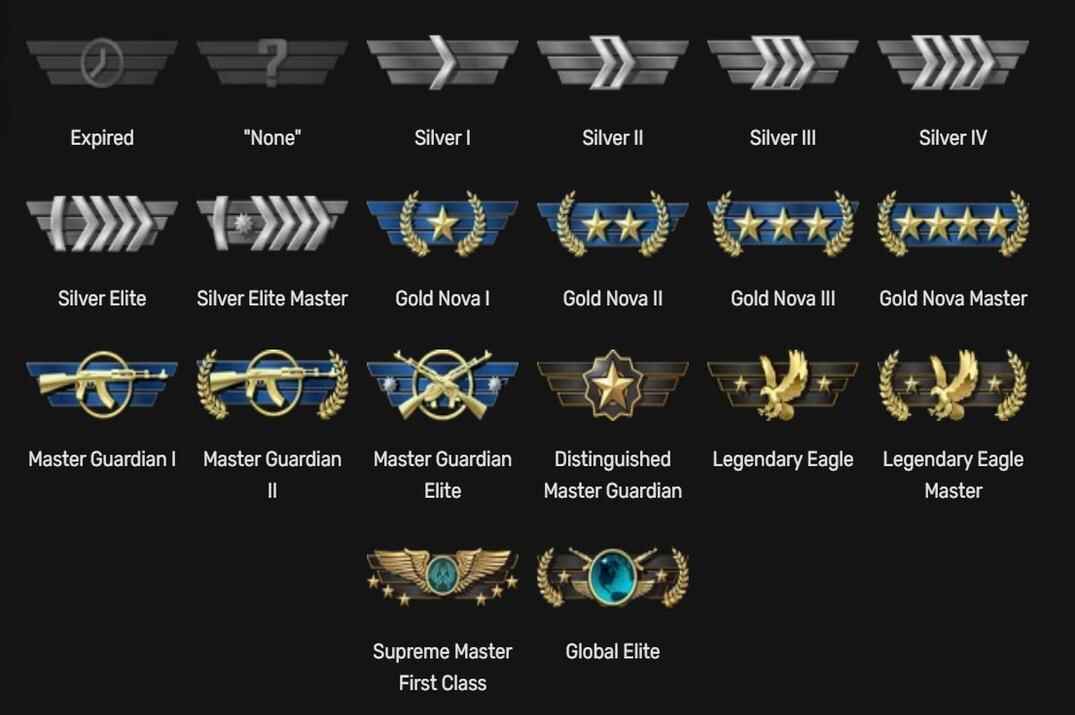
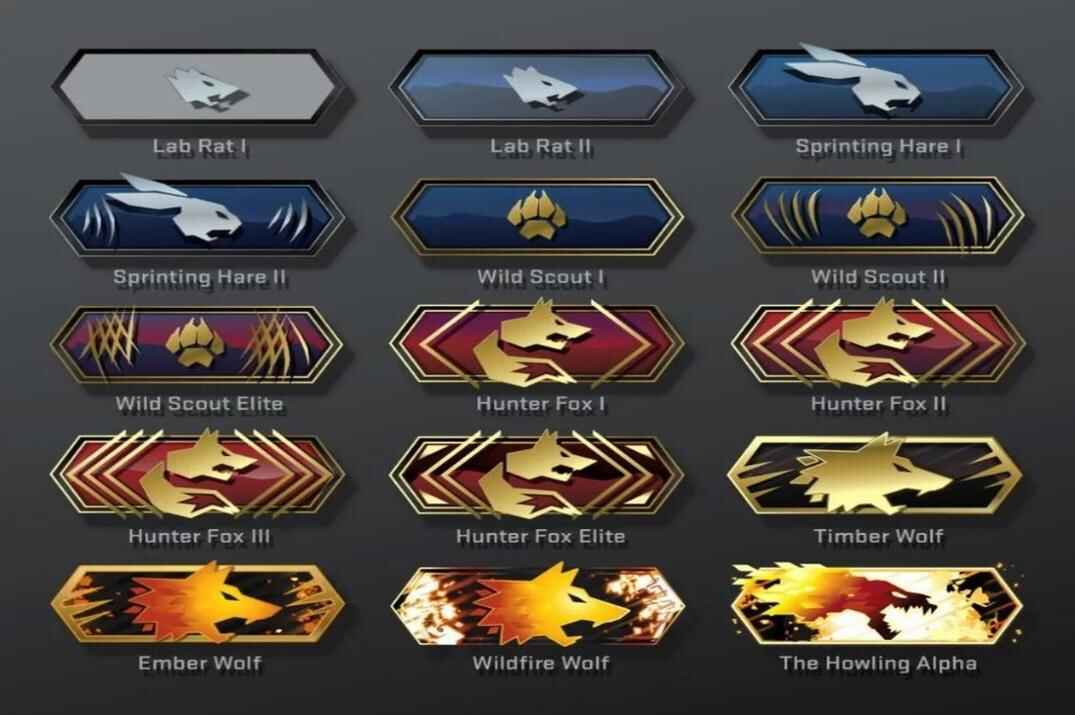
In 2018, Danger Zone introduced a battle-royale-inspired mode with a separate badge. Despite visual differences, all systems relied on similar skill-based matchmaking principles.
Still, the classic 5v5 Competitive mode retained its familiar 18-rank system all the way from 2012 to 2023 - offering consistency and familiarity to the player base.
Then came Counter-Strike 2 in 2023, bringing major changes. Two ranking systems now run in parallel: an updated Competitive mode where ranks are tied to individual maps, and a new Premier mode based on a global numerical CS Rating.
Valve introduced this new structure under the tagline "Beyond Global", signaling a shift beyond the old Global Elite status - toward a more dynamic and transparent skill measurement.
Competitive Mode in Counter-Strike 2
A familiar system, but with some serious changes

Competitive was the first official matchmaking mode in Counter-Strike, where players were matched based on skill and placed into one of 18 ranks - from Silver I to Global Elite - after completing a placement phase. To get ranked, you needed to win 10 matches.
In CS:GO, ranks were global - meaning your performance across all maps contributed to a single Skill Group. When you played Inferno, Nuke, or Dust2, wins and losses were counted together, and a hidden rating determined your visible rank. The format followed a classic MR15 setup: up to 30 rounds per match, side switch at 15, and a win condition of 16 rounds. If the match ended 15:15, it was a draw - no overtime. Each round lasted 1 minute 55 seconds, with 15 seconds for the buy phase.
With Counter-Strike 2, this system received major updates. While the 18 familiar ranks remain, they are now tied to individual maps. That means you can be Global Elite on Dust2, but only Gold Nova on Mirage. To get ranked on all 14 Competitive maps, you'll need to win 10 matches on each - a system that better reflects your actual performance on specific maps.
The match format also changed. CS2 uses the MR12 format - a maximum of 24 rounds, with victory going to the first team to reach 13. If the score hits 12:12, overtime begins: 6 extra rounds (3 per side), with each player starting on $10,000. The team that wins 4 out of 6 takes the match. If it ends 3:3, another full overtime begins - and this can theoretically repeat forever until a winner is decided.
How the Glicko-2 Ranking System Works
When CS:GO first launched, Valve never publicly disclosed how its ranking algorithm actually worked. The developers didn’t release any formulas or clarify how different factors - like personal stats, win streaks, or in-game impact - influenced a player's rank, either initially or over time.
The closest thing to an explanation came from a comment by Valve employee u/vitaliy_valve on Reddit. Responding to a post about CS:GO's ranking system, he wrote:
"The CS:GO competitive ranking system started with ideas based on the Glicko-2 rating model and improved over time to better fit the CS:GO player base. All computations are performed on our matchmaking backend, and multiple matchmaking parameters describing a scientific set of rating variables are represented to players as their Skill Group. You should be able to find papers on rating systems involving rating volatility and rating deviations online to get a better idea about why our complex competitive matchmaking parameters cannot be represented as a single numeric value".
-
Sources:
- Reddit (2013): vitaliy_valve’s comment: link
- Discussion thread (2019): Glicko-2 and CS:GO ranks: link
What Is Glicko-2 and How Does It Work?
Glicko-2 is an advanced version of the Elo rating system, developed by Professor Mark Glickman. Unlike Elo - which only tracks wins and losses - Glicko-2 also considers how reliable your current rating is, how volatile your recent performance has been, and how active you are as a player.
If you haven’t played in a while, the system becomes less confident in your rating - and each future match (win or loss) carries more weight.
Elo, by comparison, is the classic rating system invented by Arpad Elo. It’s used in chess, tennis, football rankings, and many online games. Elo is straightforward: win and your rating goes up, lose and it goes down.
So why was Glicko-2 a good fit for CS:GO? Because it doesn't just track results - it models the probability of victory based on relative player strength and confidence in that estimate. The fewer matches you’ve played, the more impactful each result becomes. This allowed CS:GO to implement a more adaptive matchmaking system, one that could respond to player form and make smarter, more dynamic matchups over time.
Ranks in CS2 Competitive

While Counter-Strike 2 introduced a new logic to ranking - assigning ranks separately for each map - the actual rank system and icons remained the same. There are 18 total ranks, grouped into several divisions.
Silver
 Silver I Silver I |
 Silver II Silver II |
 Silver III Silver III |
 Silver IV Silver IV |
 Silver Elite Silver Elite |
 Silver Elite Master Silver Elite Master |
This is the entry-level tier, home to beginners and players still learning the basics - movement, aim, spray control, maps, and timing. Teamplay is inconsistent, but it’s where players lay the groundwork for future growth.
Gold Nova
 Gold Nova Gold Nova |
 Gold Nova II Gold Nova II |
 Gold Nova III Gold Nova III |
 Gold Nova Master Gold Nova Master |
This is the middle tier, where most active players find themselves. At this level, coordination starts to matter. Basic strategy, communication, and simple team play become increasingly important. Matches are more challenging, and success often depends on synergy and map awareness.
Master Guardian
 Master Guardian I Master Guardian I |
 Master Guardian II Master Guardian II |
 Master Guardian Elite Master Guardian Elite |
 Distinguished Master Guardian Distinguished Master Guardian |
Now we’re entering the advanced tier. Players here typically have strong map control, solid utility usage, and can adapt mid-match. Mistakes become costly, and winning requires discipline, teamwork, and consistent decision-making.
Elite Ranks
 Legendary Eagle Legendary Eagle |
 Legendary Eagle Master Legendary Eagle Master |
 Supreme Master First Class Supreme Master First Class |
This is where things get serious. Precision, strategy, and consistency are key. Players here show high mechanical skill, refined economy management, and well-developed tactics. Only about 3–5% of players reach this level.
Global Elite
 The Global Elite The Global Elite |
The highest rank in the system. Fewer than 1% of players ever reach it. Every detail - positioning, grenades, timings - can decide the outcome of a round. Playing at this level demands full focus, strong game sense, and top-tier team coordination.
Player Distribution
In CS:GO, the distribution of players across ranks was intentionally uneven. Most players sat in the middle of the ladder - in the Gold Nova and Master Guardian ranges - while the top rank, Global Elite, was reserved for only about 1% of the player base. According to 2023 estimates, Global Elite accounted for just 0.7% of all ranked players. On the other end, the Silver division made up roughly a quarter of the population.
Valve regularly adjusted its matchmaking algorithms to maintain this target distribution. For example, in Fall 2015 and again in November 2017, major updates were rolled out, and many players noticed significant shifts in their ranks. The goal of these changes was to keep Global Elite truly elite, and center the median rank around Gold Nova III–IV. The general breakdown looked something like this:
| Global
Elite – <1% |
Supreme Master First Class – ~2–3% |
Gold Nova – largest segment of the player base |
This setup might seem artificially limited, but it helped preserve the balance and stability of the ranking system. Without periodic adjustments, ranks would lose meaning - weaker players could rise too high, and the prestige of top tiers would erode.
Ranks are based on objective performance - wins, losses, and round impact, but the system remains dynamic. Valve adjusts matchmaking behind the scenes from time to time, and players usually notice it when ranks start shifting across the board.
In Counter-Strike 2, the distribution follows a similar model. By late 2024:
- Around 25% of players fall into Silver ranks
- Over 30% are in the Gold Nova range
- Top ranks (Legendary Eagle, Supreme, Global) account for just 1–2% of the player base
That’s the point: elite ranks stay rare, the ladder stays competitive, and progression still feels earned.
Maps in Competitive Mode
From the very beginning, CS:GO’s Competitive mode was built around map selection. Players would choose which maps they were willing to play, and matchmaking would search within that pool. When the system launched in 2012, there were only five classic maps in the active pool: Dust2, Inferno, Nuke, Train, and Mirage - all staples dating back to the CS 1.6 era.
By 2013–2014, Valve began expanding the map pool significantly, adding Cache, Overpass, and Cobblestone, bringing the total to eight. Around that time, map rotation became a regular feature - where maps would be temporarily removed or replaced with new or reworked versions.
In 2015, Nuke was removed and a revamped Train was brought back. In 2017, the original Dust2 was taken out, only to return in 2018 with updated visuals. Around the same time, Cobblestone was phased out completely. In 2019, Vertigo entered the pool, replacing Cache, and sparked plenty of debate within the community due to its vertical layout and experimental design. Valve continued shaking things up in 2021 by replacing Train with the jungle-themed Ancient.
Perhaps the most controversial change came in 2022, when Valve removed Dust2, one of the most iconic maps in CS history. It was replaced by Anubis, a community-made map with an Egyptian setting. By the time CS2 launched in 2023, the active pool had stabilized around seven maps: Mirage, Inferno, Nuke, Overpass, Vertigo, Ancient, and Anubis - each with its own meta, timing, and strategic identity.
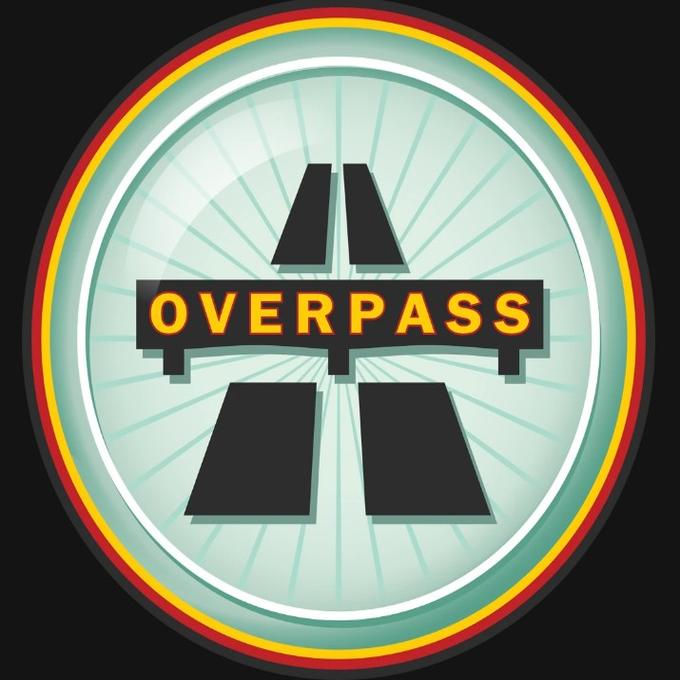
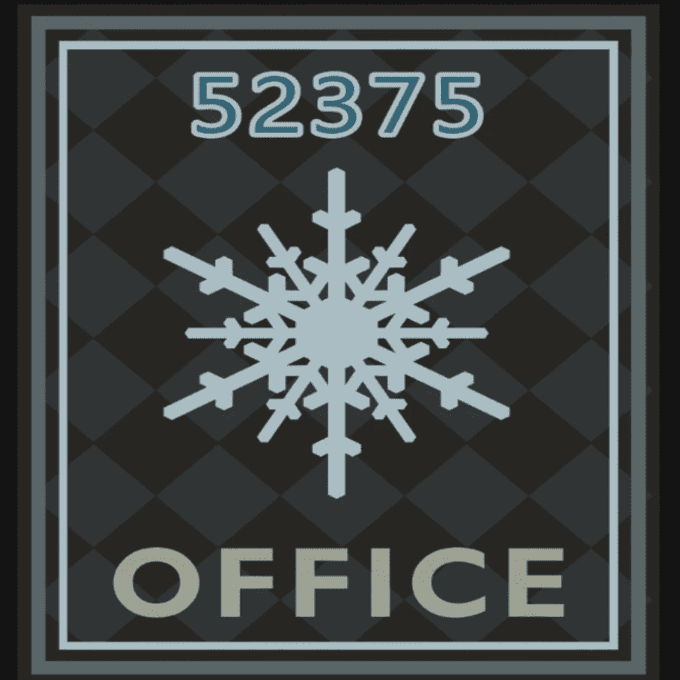
As of early 2026, CS2’s Competitive map pool includes 14 maps.










Warden

Stronghold

Alpine
Don’t try to grind all 14 maps at once - it usually ends in frustration. Pick one or two maps and learn them properly: utility, common setups, timings, economy flow. Once your understanding improves, your rank tends to follow. After that, expanding to other maps becomes much easier.
Premier Mode in Counter-Strike 2
Competitive play with a professional twist

Premier Mode, also known as Active Duty Pick-Ban, is the primary ranked mode in Counter-Strike 2. It’s built around a more transparent matchmaking system, a global numerical rating (CS Rating), and a map veto process similar to what’s used in professional tournaments.
Unlike traditional Competitive, Premier emphasizes deeper strategy and more serious play. Before the match begins, both teams take turns banning maps from the active duty pool until one remains. Then, one team selects which side to start on - Terrorists or Counter-Terrorists. This format adds layers of tactical depth and rewards preparation.
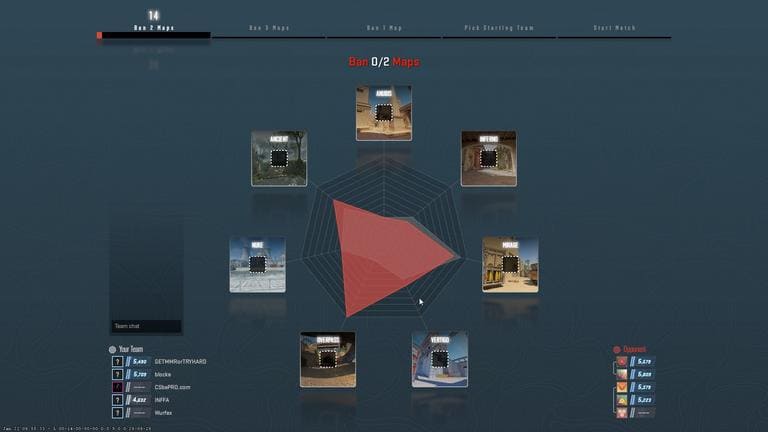
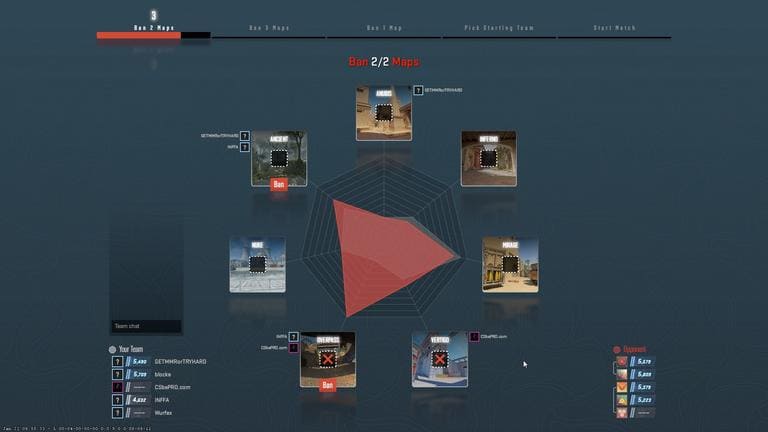
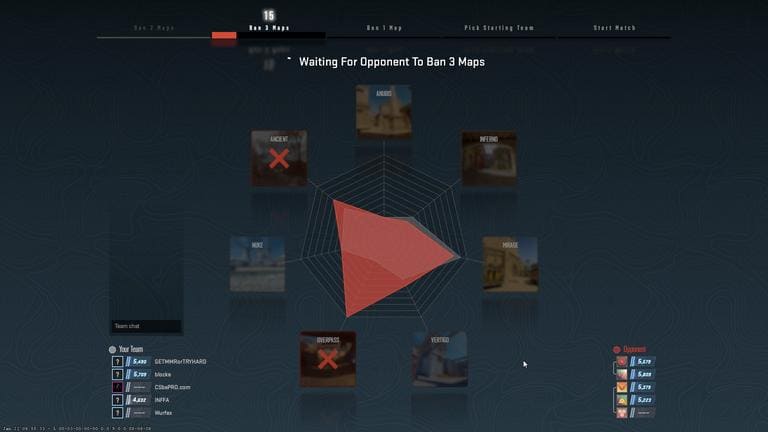
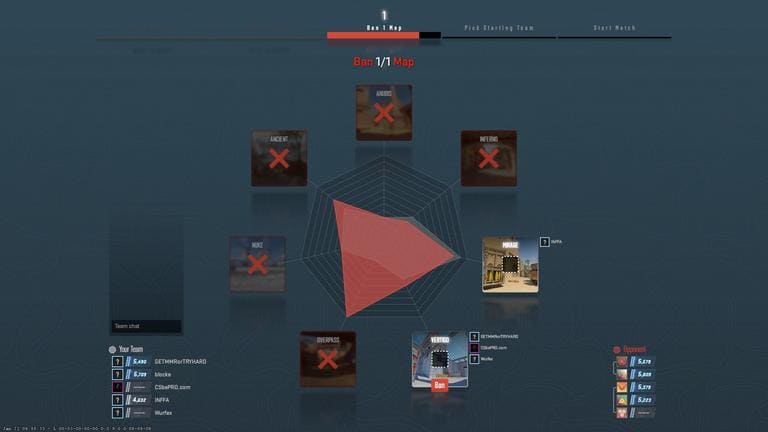
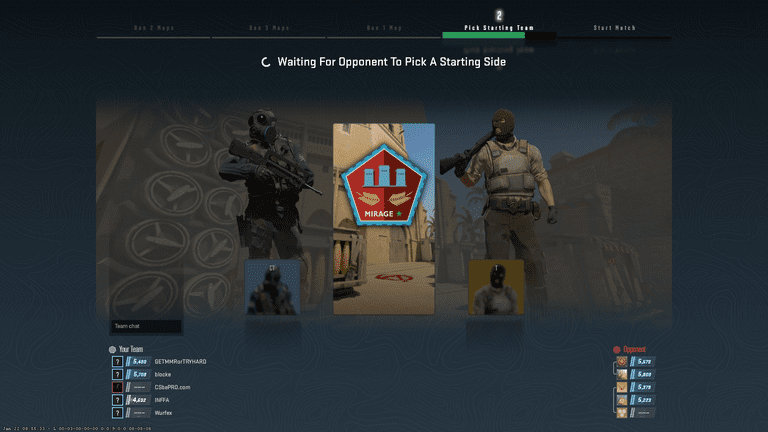
Matches in Premier always play to a decisive result. If the score reaches 12:12, overtime begins - six extra rounds, three per side. The team that wins 4 out of 6 takes the match. If overtime ends in a 3:3 tie (final score 15:15), the match is officially recorded as a draw. Either way, CS Rating will always shift - there are no meaningless matches.
The Premier map pool includes 7 maps.
What is CS Rating?
CS Rating is a numerical skill rating used in Premier Mode - similar to ELO or MMR in other competitive games. It’s shown directly in your CS2 profile and used by the matchmaking system to pair you with opponents at a similar skill level.
To get your CS Rating, you need to complete calibration by winning 10 matches in Premier Mode. Based on your performance - wins, losses, and the strength of your opponents - the system assigns a starting score, usually beginning at 1000 or higher. From there, your rating increases or decreases depending on match outcomes and (presumably) your individual contribution.
Behind the scenes, CS Rating behaves very similarly to a traditional Elo-style system - you gain more for beating stronger opponents and lose more when falling to weaker ones.
Unlike Competitive mode, where ranks are tied to individual maps, CS Rating is global - a single number that reflects your overall skill, regardless of map. That’s why many players treat Premier as the closest thing CS2 has to a true "overall skill" rating.
Leaderboards in Premier Mode
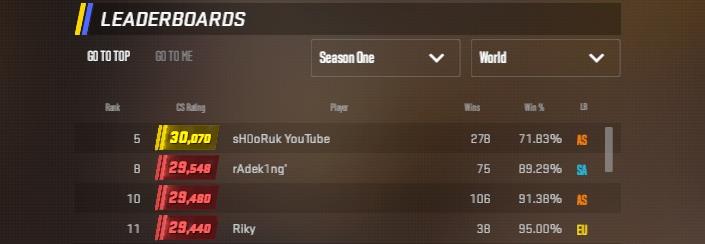
In CS2’s interface, under Premier -> Leaderboards, you’ll find both global and regional leaderboards. These display the top 1000 players by CS Rating - either worldwide or within your selected region. There’s also a convenient "Go to Me" button that instantly locates your position among friends or on the regional chart.
Each leaderboard entry shows:
- Rank (current position)
- CS Rating
- Player (nickname)
- Wins (total)
- Win % (winrate)
- Region
Valve officially describes CS Rating as a "precise representation of your skill" in CS2.
For many players, the leaderboard is the ultimate motivation to grind Premier - it’s climbing to the top, chasing a personal best, or simply beating your friends. Every competitive season ends with a full rating reset, followed by a new round of placement matches. The leaderboard starts fresh, and the race begins again.
CS Rating and Color Tiers
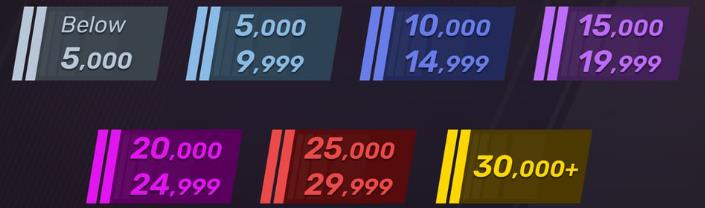
In Premier Mode, players don’t get classic ranks like Silver or Global Elite. Instead, they’re assigned a CS Rating - a numerical value that reflects skill level. To make it easier to quickly identify someone's skill, the game also displays your rating in color, which acts as a visual tier system.
Currently, there are 7 color tiers based on your CS Rating:
| Color | Tier Name | Approximate Rating |
|---|---|---|
| Gray | Beginner | up to ~4999 |
| Light Blue | Lower Mid | ~5000–9999 |
| Blue | Solid / Average | ~10,000–14,999 |
| Purple | Above Average / High | ~15,000–19,999 |
| Pink | Very High | ~20,000–24,999 |
| Red | Elite Tier | ~25,000–29,999 |
| Yellow | Top Level / Semi-Pro | 30,000+ |
Note: Valve regularly updates its competitive systems, so the rating color thresholds can change at any time. I wouldn’t be surprised if everything shifts dramatically - especially considering how recently Valve overhauled the skins market.
After completing your placement matches (10 wins), you’ll be assigned a starting CS Rating - typically somewhere between 5000 and 10,000. From there, every Premier match affects your rating:
- Win -> Rating goes up
- Loss -> Rating drops
How much it changes depends on the relative ratings of both teams and possibly your individual performance. Beating a stronger team gives you more points, while losing to a weaker team results in a bigger penalty.
Many players have noticed that win streaks boost your gains, while losing streaks accelerate your losses. This suggests that the system tracks not only each match, but also your overall performance trend.
Comparing Competitive and Premier Modes
A side-by-side look at how Competitive and Premier really work
Both modes are competitive and impact your rank progression - but they differ significantly in matchmaking, rating systems, and how matches are structured.
Key Differences Between Competitive and Premier in CS2
| Feature | Competitive Mode | Premier Mode |
|---|---|---|
| Map Selection | Players choose individual maps | Pick/Ban draft from 7 Active Duty maps |
| Match Format | MR12 (First to 13), unlimited overtimes | MR12, one overtime (6 rounds), ends in a draw if tied |
| Ranking System | 18 Skill Groups, tracked per map | CS Rating - single global numeric ranking |
| How to Get Ranked | 10 wins on each map | 10 wins in Premier |
| Rating Changes | Affects rank only on the current map | Changes after every match (±100–300 points) |
| Side Selection (T/CT) | Not available | Yes - voted after map is picked |
| Leaderboards | None | Yes - Global & Regional Leaderboards |
| Best For | Practicing specific maps, casual ranked play | Global progress, competitive/tournament-style matches |
Can You Compare Competitive Ranks to CS Rating?
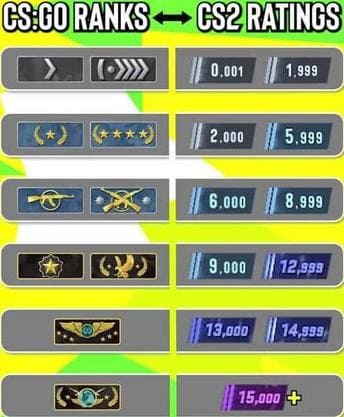
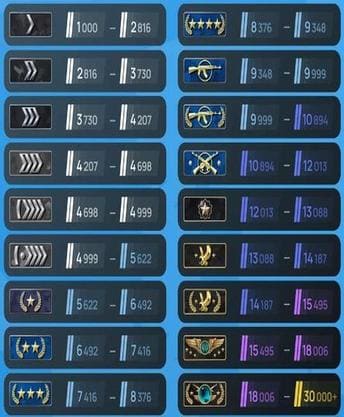
There is no official conversion between CS:GO Skill Groups and CS2 Rating. I’ve reviewed more than a few comparison charts, and most of them contradict each other. They’re based on anecdotal estimates, not official data.
Some claim 25,000 CS Rating equals Global Elite. Others say it starts at 30,000+. The truth is - there’s no fixed formula, and here’s why:
- CS Rating is dynamic - it constantly updates based on recent performance. Competitive ranks, on the other hand, stay fixed until you play that map again.
- Map-specific differences - in Competitive, you can be Global Elite on Dust2 but Gold Nova on Mirage. In Premier, there's one rating for everything.
- Different evaluation systems - Premier uses a continuous rating scale, while Competitive assigns static visual ranks based on map performance.
Competitive and Premier are two separate ranked systems. They were built for different purposes - and for different types of players.
Competitive is about mastering individual maps and improving step by step. Premier is about your overall level and competing in a more structured, tournament-style environment.
Profile Rank (XP Level)
How XP works and what you earn for leveling up

Apart from competitive ranks, Valve introduced the profile XP system back in 2015 - a level-based progression that tracks your overall activity on official servers. Starting with Operation Bloodhound in May 2015, players began earning XP and leveling up from Rank 1 to 40.
At first, this system was mostly cosmetic, but it also served a practical purpose: to play Competitive, players had to reach at least Rank 2 - making sure newcomers spent some time learning the basics in casual modes.
The main reason to level up is to earn a Service Medal. Once you hit Rank 40, you can reset your level and receive a unique medal that’s permanently added to your inventory.
Each level requires 5,000 XP. You earn XP by playing official game modes. In addition:
- Every weekly level-up gives a case, two skins, and a graffiti
- Battle Pass owners receive additional rewards from operation collections
- Players who participate in Overwatch get bonus XP for correct verdicts
Service Medals
Service Medals are special items displayed next to your avatar in your CS2 profile. The first medal was introduced in 2015 - back then, reaching Profile Rank 40 allowed you to reset your level and earn the "2015 Service Medal".
Since 2016, medals have been tiered: there are now 6 color levels, showing how many times a player has reached Rank 40 within a single calendar year.
| Tier | Color | Meaning |
|---|---|---|
| 1 | Gray | First reset of the year |
| 2 | Green | Second reset |
| 3 | Blue | Third reset |
| 4 | Purple | Fourth reset |
| 5 | Pink | Fifth reset |
| 6 | Red | Sixth reset (maximum tier) |
Each medal keeps its yearly design (2015, 2016, ..., 2025), while the color shows how far you progressed that year. For example, the 2025 medal has a laurel wreath design - and it stays the same shape across all color tiers.
To claim the medal, you must click Get Service Medal - this resets your profile level back to 1, and you can start progressing again.
Note: You won’t lose access to Competitive mode - there’s no need to unlock Rank 2 again.
Is the Red Medal Real?

To get the red Service Medal, you must reach Rank 40 six times in a single year - that’s 240 total levels. With XP limits and weekly restrictions in place, this is nearly impossible to achieve legitimately. Based on estimates, it would take 12+ hours of daily play throughout the entire year.
As a result:
- Red medals are extremely rare
- Often suspected to be earned using bots or account boosting
- Most dedicated players stop at purple or pink (Level 4-5 medals)
- Blue and green medals are common among regular active players
A Symbol of Prestige
The Service Medal is a mark of experience and dedication. It doesn’t affect gameplay, but it shows how committed a player is. If someone has a pink 2023 medal, it’s safe to assume they played a lot that year.
Old medals are stored in your inventory and often collected for their unique designs. Every year - usually on January 1st - Valve releases a new medal with a fresh look. For many players, collecting them all from 2015 to the present has become a long-standing tradition.
Earning Experience (XP) in CS2

In Counter-Strike 2, players earn XP (experience points) by participating in all official game modes - including Competitive, Premier, Casual, Wingman, Deathmatch, and others. In Competitive and Premier matches, you gain 30 XP for every round your team wins.
In non-competitive modes, different formulas apply - for example, in Deathmatch, XP is calculated as your score multiplied by 0.2.
There’s also a weekly XP bonus system. The first 5,000 XP you earn each week is boosted:
- ×3 multiplier for the first ~3,500 XP
- Then gradually drops to ×1
Once the bonus is used up, XP is awarded at the regular rate.
However, if a player earns more than 11,167 XP in a single week, a penalty kicks in - the multiplier drops sharply to 0.175, making further XP gains highly inefficient.
This system discourages extreme grinding and helps preserve the value of Service Medals by promoting steady, balanced activity throughout the year.

