

Counter-Strike 2 Ranking System
Competitive, Premier and Profile XP. Three systems, three different things measured.
CS:GO launched in 2012 with a single Competitive ranking system and no public formula for how Skill Groups were calculated. CS2 now uses three separate systems: map-based Competitive Skill Groups, the numerical CS Rating in Premier, and the Profile Rank earned through XP.
These systems are independent. Increasing your Profile Rank does not change your Premier rating, and your CS Rating does not affect your Competitive rank on Mirage.
The guide covers all three: how the ranks are earned, what CS Rating does after each match, what the colours mean, and what changes when a season ends. Where Valve has never explained something, I say so instead of guessing.
September 2026
Verified against Premier Season 5: seven-map pool with Cache, two-win Competitive calibration, current XP multipliers.
- Cache replaced Overpass in Active Duty, July 2026
- Competitive Skill Groups expired in the January 2026 recalibration
- Rank distribution redrawn after that reset - over half of accounts now sit in Silver
From CS:GO to CS2
How CS:GO’s global rank became map-based Competitive ranks and Premier CS Rating.
CS:GO launched in August 2012 with Competitive matchmaking and eighteen skill groups, Silver I through Global Elite. Ten Competitive wins were required to receive your first Skill Group. Valve never said how it was calculated, and that stayed true for the next decade.
The rank was global - one badge for all maps. Prime arrived in April 2016 to separate paying accounts from the free pool, first unlocked at profile level 21, then paid outright from 2021. Wingman came in 2017 with its own 2v2 ladder, and it is still here. Danger Zone followed in 2018 with a separate badge and did not survive the move to CS2.
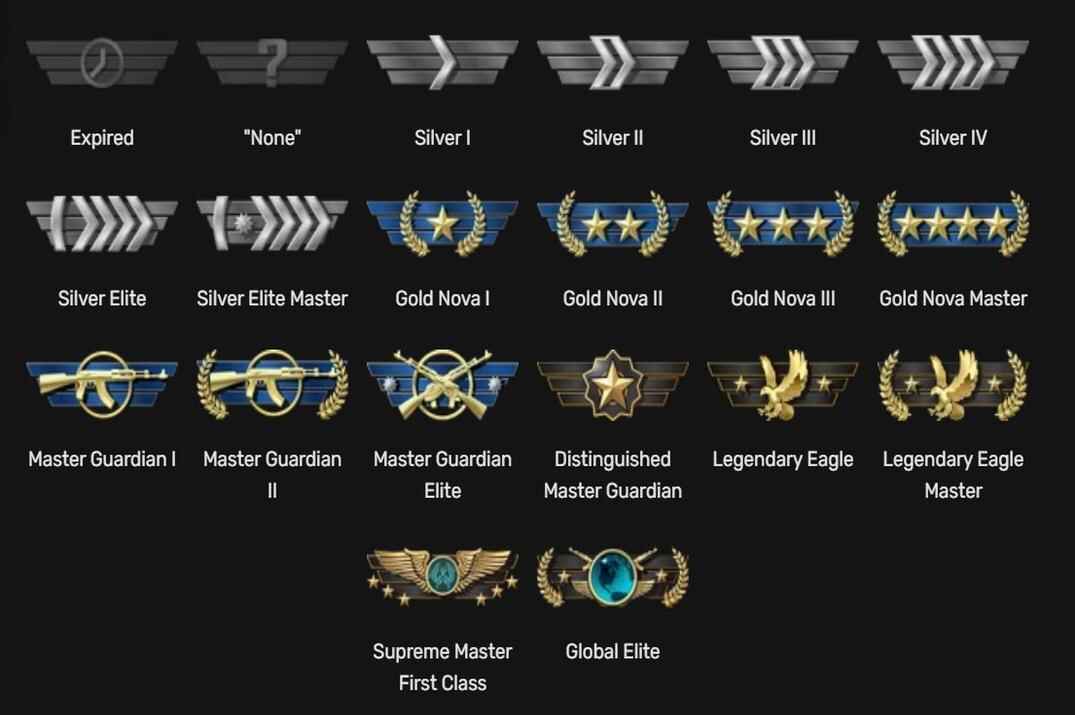
The main Competitive system still used the same eighteen Skill Groups, with one rank for the entire account, until CS2 replaced CS:GO in 2023.
CS2 replaced the global Competitive rank with two separate matchmaking systems. Competitive kept the eighteen ranks but tied them to individual maps - you can be Master Guardian on Mirage and Silver on Nuke, and both are correct. Premier arrived alongside it with a visible number instead of a badge, a map veto before the match, and leaderboards. Valve introduced Premier under the Beyond Global tagline, with CS Rating replacing the traditional Skill Group as the main visible measure of Premier progress.
Since then Premier has become the main ladder. Seasons reset it, the pro map pool follows it, and most players quoting a rank in 2026 are quoting a CS Rating.
Competitive Mode in CS2
Eighteen Skill Groups, with a separate rank for each map.
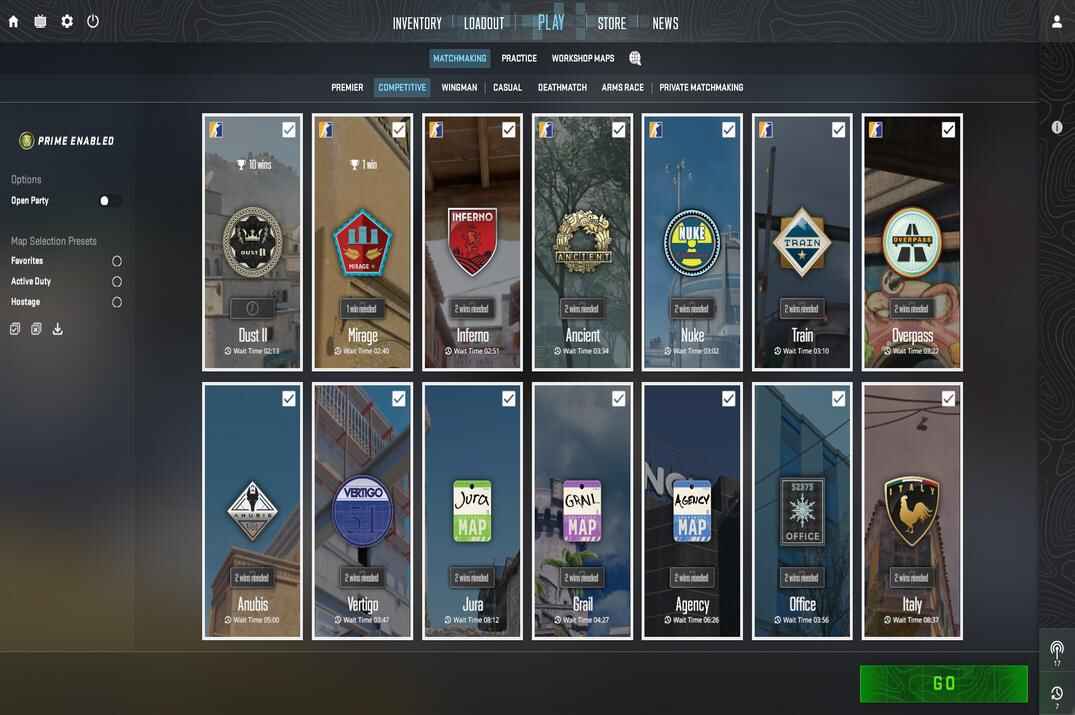
You choose the maps you want to queue for, and each map has its own Competitive rank. Two wins on a map are required to receive its Skill Group. Valve reduced the calibration requirement from ten wins to two in June 2024.
Because ranks are per map, a profile can hold fifteen different ones. Master Guardian on Mirage and Silver IV on Nuke is not a contradiction, it is two maps you have played different amounts.
The format is MR12: first to 13, twenty-four rounds maximum. At 12:12 the match ends in a draw - Competitive has no overtime. That is the part people get wrong most often, because Premier does have one.
Competitive ranks can become inactive. After roughly a month without a win on a map, its Skill Group is hidden until you win on that map again.
The January 2026 reset
On 21 January 2026, alongside the start of Premier Season 4, Valve adjusted the hidden per-map values and expired every existing Skill Group. Everyone had to win again before their badges came back.
If you returned to CS2 after a break and found your ranks gone, that was this, not a bug. It also explains the lower rank distribution shown further down.
How the rating works
Valve has never published the formula. The closest thing to an official answer is a Reddit comment from a Valve employee in 2013, saying the system started from ideas in the Glicko-2 model and was adjusted over time to fit the player base, and that the underlying variables cannot be reduced to a single number - which is why you get a badge instead of a score.
Glicko-2 is a refinement of Elo. Elo tracks wins and losses and nothing else. Glicko-2 also tracks how confident the system is in your rating and how erratic your recent results have been. Stop playing for a while and that confidence drops, so your next few matches can affect the rating more than usual.
It is unknown if CS2 still uses anything close to Glicko-2. That comment is thirteen years old and describes CS:GO. Use it as historical context, not as documentation of the current CS2 system.
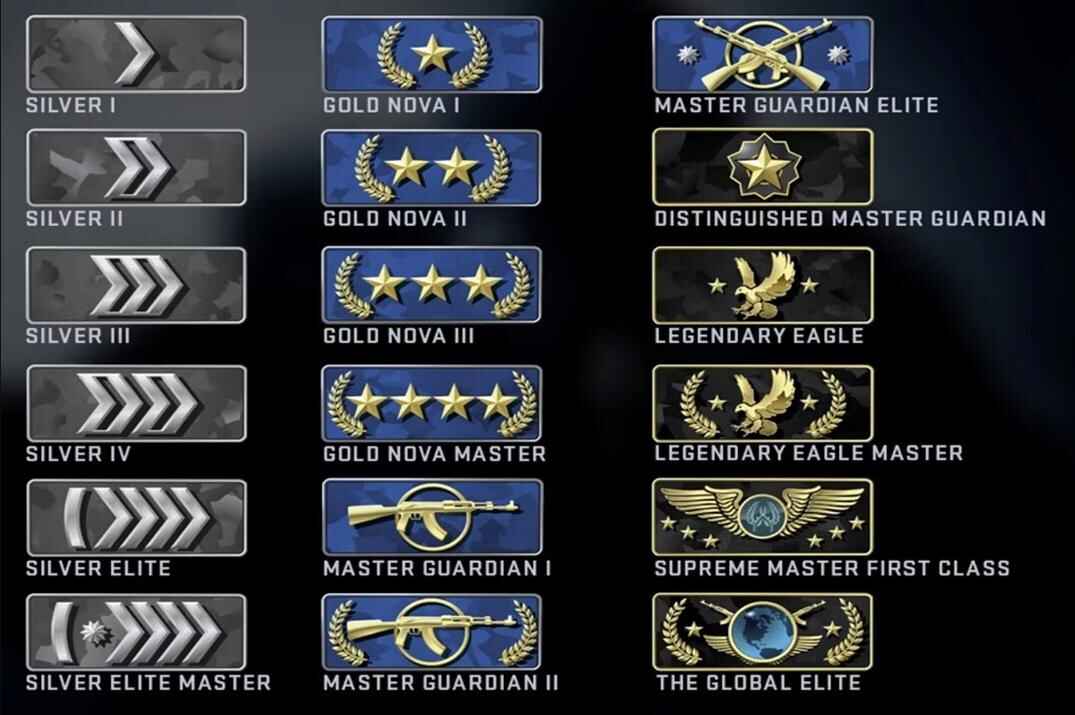
The eighteen ranks in Competitive
Silver
 Silver I |
 Silver II |
 Silver III |
 Silver IV |
 Silver Elite |
 Silver Elite Master |
The six Silver ranks currently contain the largest share of Competitive players. After the January 2026 reset, more than half of ranked accounts fall into this tier.
Gold Nova
 Gold Nova I |
 Gold Nova II |
 Gold Nova III |
 Gold Nova Master |
The middle. Four ranks from Gold Nova I to Gold Nova Master. This tier currently contains about a quarter of ranked Competitive accounts.
Master Guardian
 Master Guardian I |
 Master Guardian II |
 Master Guardian Elite |
 Distinguished Master Guardian |
Master Guardian I through Master Guardian Elite account for a much smaller share of the current Competitive distribution.
Eagle and above
 Legendary Eagle |
 Legendary Eagle Master |
 Supreme Master First Class |
 The Global Elite |
These four ranks together account for 3.7% of ranked accounts, with Global Elite at just 0.3%. Premier now provides the separate numerical CS Rating and leaderboard system.
Where players actually sit
Distribution as of July 2026, after the January recalibration:
| Tier | Share of ranked accounts |
|---|---|
| Silver I – Silver Elite Master | 56.7% |
| Gold Nova I – Gold Nova Master | 26.6% |
| Master Guardian I – Master Guardian Elite | 11.2% |
| Distinguished Master Guardian | 2.0% |
| Legendary Eagle | 1.4% |
| Legendary Eagle Master | 1.5% |
| Supreme Master First Class | 0.5% |
| The Global Elite | 0.3% |
In CS:GO the curve peaked in the middle, around Gold Nova III, and Silver held roughly a quarter of the population. Now over half of all ranked accounts are Silver.
Two things pushed it there. The January reset expired existing Skill Groups, while the current two-win calibration can assign a new rank quickly. Competitive also maintains a separate Skill Group for each map, so the current distribution is not directly comparable with the single global rank used in CS:GO.
Maps in Competitive
The pool started at five maps in 2012 - Dust2, Inferno, Nuke, Train and Mirage, all carried over from 1.6. It grew, rotated and argued with itself for eleven years: Cobblestone in and out, Cache swapped for Vertigo in 2019, Train for Ancient in 2021, Dust2 pulled for Anubis in 2022 to general outrage.
Competitive no longer follows the Premier rotation. It runs fifteen maps, including the ones Premier has dropped and the community maps Valve keeps adding.
 Cache
 Anubis
 Inferno
 Mirage
 Dust2
 Nuke
 Ancient
 Train
 Vertigo
 Overpass
 Boulder
Fachwerk
Shelter
 Office
 Italy
Do not try to calibrate all fifteen. Two wins is cheap, so it is tempting, but a badge from two games tells you nothing. Pick one or two maps, learn the utility and the timings, and let the rank follow.
Premier Mode in CS2
One number, seven maps, a veto before the match. The main ladder now.
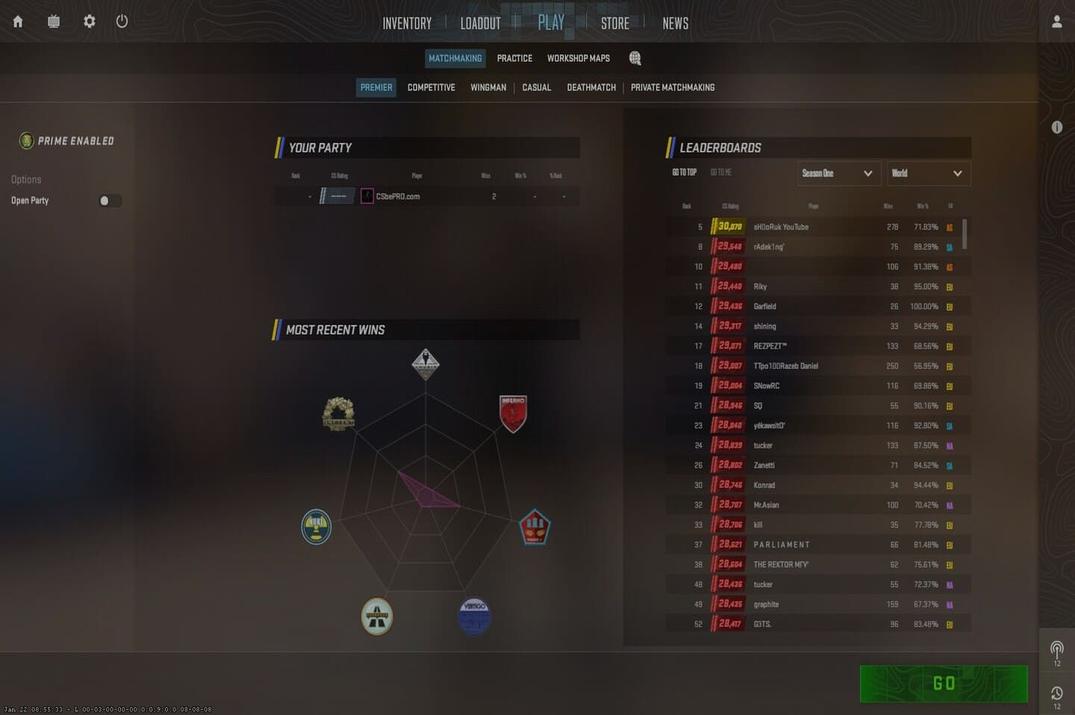
Premier does what Competitive does not: it gives you an actual number, shows you how much it moved after every match, and puts the top of the ladder on a public board. That transparency is the whole reason it took over.
To queue you need Prime and Profile Rank 10. Then ten wins to calibrate - losses and draws do not count toward the ten, and the rating stays hidden until the tenth win.
The format is MR12, first to 13. At 12:12 you get one overtime: six rounds, three per side, $10,000 to start. Win four of the six and the match is yours. If overtime ends 3:3, the match is a draw at 15:15 and that is where it stops - Premier does not run a second overtime. A draw can also change your CS Rating.
The veto
Before the match both teams strip the pool down to one map. Nobody queues for a specific map here - you queue for Premier and find out what you are playing after the bans.
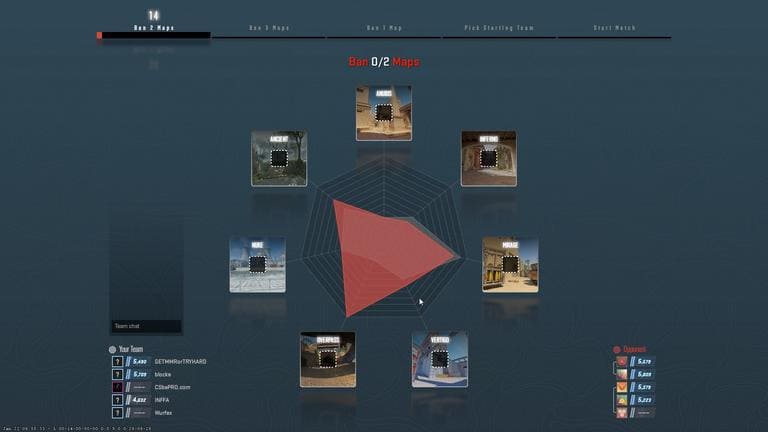
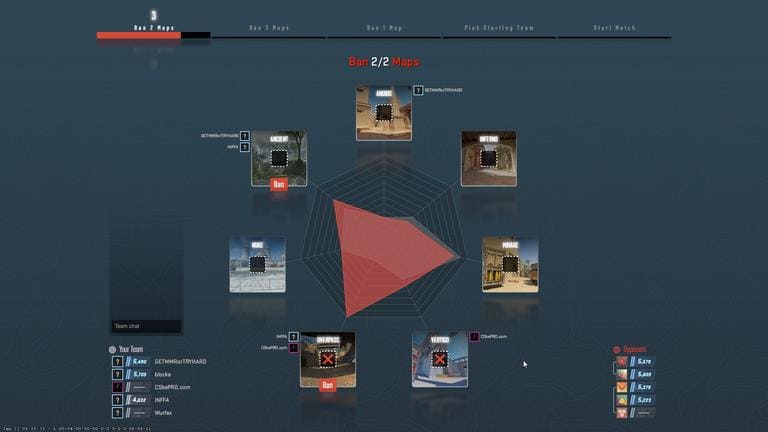
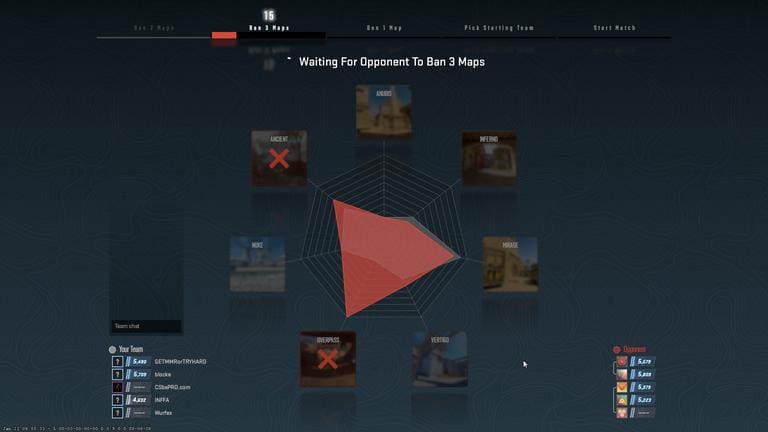
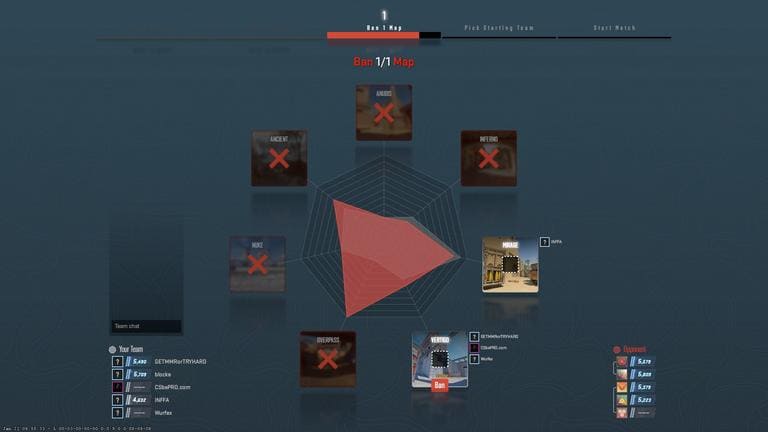
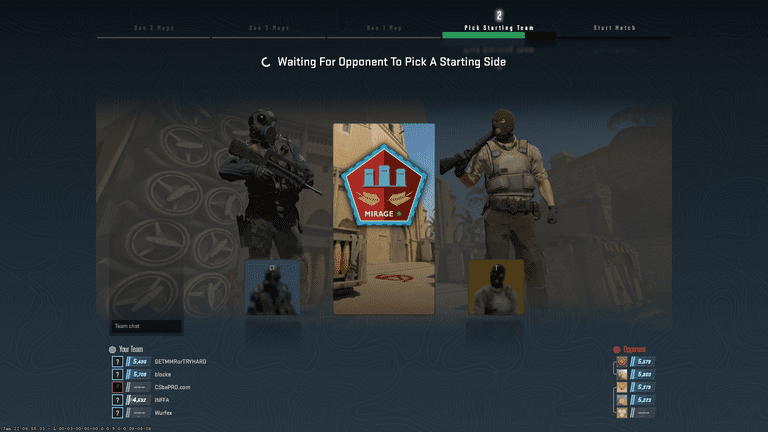
It is the same structure professional teams use, which cuts both ways. You get to remove the two maps you hate, and so does the enemy - so the map you end up on is usually the one nobody felt strongly about.
The map pool
Seven maps, called Active Duty. Valve changes the pool between Premier seasons. So far, the map removed has often been one of the least-picked at the previous Major, but Valve has never confirmed this as an official rule. Current pool, since Season 5:
Cache came back in July 2026 after seven years away, replacing Overpass. The version in the game now is a Source 2 rebuild, so old knowledge of it is worth less than people expect.
What CS Rating does
After calibration you get a number, usually somewhere between 5,000 and 15,000 depending on how the ten wins went and who you beat. From there every match moves it.
The exact formula is not public. Your possible rating gain and loss are shown before the match begins, so individual performance and the final round score do not change that amount. Team ratings, recent results and win or loss streaks appear to affect how much is at stake.
Unlike Competitive, the number is global. It does not care which of the seven maps you played, which is why most people treat it as the closest thing CS2 has to an overall skill number.
Rating does not decay while you are away, but leaderboard placement does - stop playing and you drop off the board until you queue again.
Colour tiers
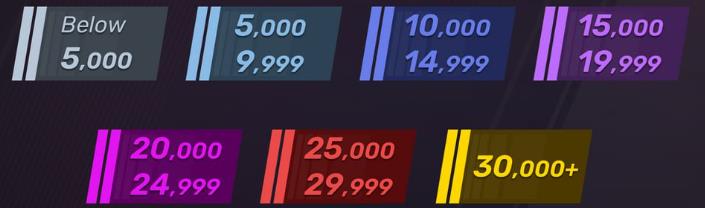
The number is shown in a colour, and the colour is what people actually read. Seven bands, each 5,000 wide:
| Colour | Rating |
|---|---|
| Grey | 0 – 4,999 |
| Light Blue | 5,000 – 9,999 |
| Blue | 10,000 – 14,999 |
| Purple | 15,000 – 19,999 |
| Pink | 20,000 – 24,999 |
| Red | 25,000 – 29,999 |
| Gold | 30,000+ |
The distribution is concentrated at the lower end. Most players sit in light blue or blue, while only a very small share reaches gold. The top of the global leaderboard has exceeded 38,000 in 2026.
Note: these thresholds are not documented anywhere by Valve. They have held since launch, but nothing stops them from being redrawn in a season update.
Leaderboards
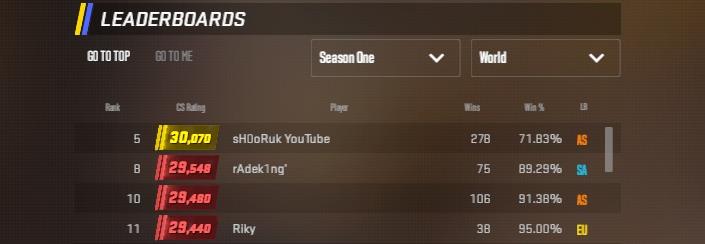
Premier → Leaderboards shows the top 1,000 by rating, globally and per region, with wins, win rate and region for each entry. There is a Go to Me button that jumps to your own position or to your friends.
The leaderboard resets at the end of each Premier season along with the seasonal ratings, so players start the next season with a new placement process.
Premier Seasons
Every few months the rating goes away and everyone starts again.
A season ends, ratings are hidden, the leaderboard clears, and you need ten wins to see a number again. A season ends, ratings are hidden, the leaderboard resets, and you need ten wins to receive a new CS Rating. Valve has not published the formula used for seasonal placement.
The map pool usually changes at the same time, one map out and one in. Five seasons so far:
| Season | Started | Map pool change |
|---|---|---|
| Season 1 | 27 September 2023 | Launched with CS2 |
| Season 2 | 28 January 2025 | Train in, Vertigo out |
| Season 3 | 16 July 2025 | Overpass in, Anubis out |
| Season 4 | 21 January 2026 | Anubis in, Train out |
| Season 5 | 8 July 2026 | Cache in, Overpass out |
Season 1 ran sixteen months because Valve had not settled on a rhythm yet. Since then it has been roughly six months each, timed around the Major calendar.
Season 4 was the disruptive one. Alongside the usual Premier reset, Valve also expired every Competitive Skill Group - the only time so far that both systems were wiped in the same update.
Season medals

The one thing you keep from a season. To get the medal you need 25 Premier wins during that season and a visible CS Rating when it closes - if your rating has expired through inactivity, no medal, regardless of how many wins you banked.
The medal's colour reflects the highest CS Rating you reached during the season. The bars show your total Premier wins, with one bar for every 25 wins, up to five.
Worth knowing at season end: people scramble in the last hours to win one match and un-expire their rating in time. If you have the 25 wins and have not played in a while, that is the thing to check before the deadline.
What to do at a reset
The first week after a Premier reset can be unpredictable because many players are still unplaced. Less experienced players may prefer to wait a week or two while more of the player base completes calibration. Valve has never confirmed that waiting improves matchmaking, so treat this as a practical strategy, not a documented mechanic.
If you play immediately, expect a wider mix of skill levels while ratings are still being rebuilt. The ten calibration wins determine your new visible CS Rating, but Valve has not published how those matches are weighted.
A map-pool change is also a good reason to spend some time learning the new map early. Knowing the basic utility, timings and common positions before it starts appearing regularly in the veto can save a lot of rough matches.
Competitive vs Premier
Two ladders on the same account, measuring different things.
| Competitive | Premier | |
|---|---|---|
| Map selection | You queue for the maps you want | Pick and ban from seven, no choosing |
| Maps in rotation | 15 | 7 |
| Format | MR12, draw at 12:12 | MR12, one overtime, then a draw |
| Side choice | No | Yes, after the veto |
| What you get | A badge, one per map | A number, one per account |
| Calibration | 2 wins on that map | 10 wins |
| To unlock | Prime, Profile Rank 2 | Prime, Profile Rank 10 |
| Expiry | About a month without a win on that map | Inactivity hides the rating; seasons reset it |
| Leaderboards | None | Global and regional, top 1,000 |
| Best for | Learning one map properly | Measuring where you actually are |
Can you convert one to the other?
No. This is the most asked question about CS2 ranks and it has a boring answer: the two systems were never linked, share no scale, and were built to do different jobs.
That has not stopped people from publishing conversion charts. Here are two of them:
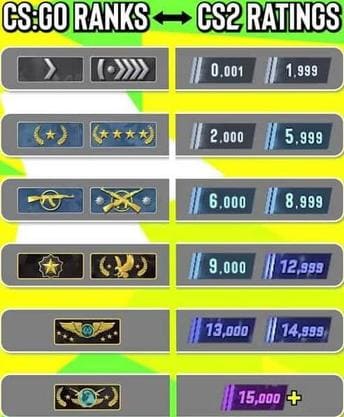
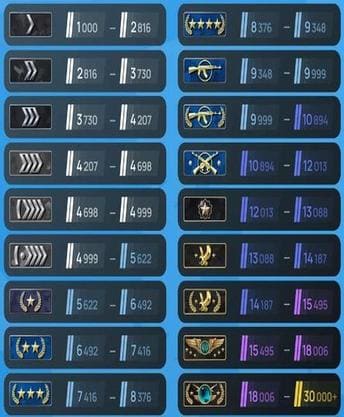
Both look official. Neither is. Compare them and they disagree - one puts Global Elite at 25,000, the other starts it above 30,000. Nobody sourced these from Valve, because there is nothing to source.
Three reasons a fixed table cannot exist:
- CS Rating moves after every match. A Competitive Skill Group only changes when you play that map, and can become hidden after extended inactivity until you win on that map again.
- Competitive is per map. Which of your fifteen badges is the one being converted?
- One is a continuous scale, the other is eighteen fixed buckets. Even if the underlying skill matched perfectly, the shapes do not.
Add the January 2026 recalibration and the picture gets worse: over half of ranked accounts now sit in Silver, so a Silver badge today means something different from a Silver badge two years ago, while the rating scale did not move at all.
Which one to play
Competitive is useful if you want to focus on a specific map. Two wins give you a Skill Group for that map, and you can keep queueing it without depending on a veto.
Premier is better if you want one rating for your overall results. CS Rating updates after every match, shows the possible gain or loss, and uses the same numerical scale for everyone.
Many players use both: Premier for CS Rating and Competitive for individual maps.
Profile Rank and Service Medals
The third system. Measures XP, not skill.
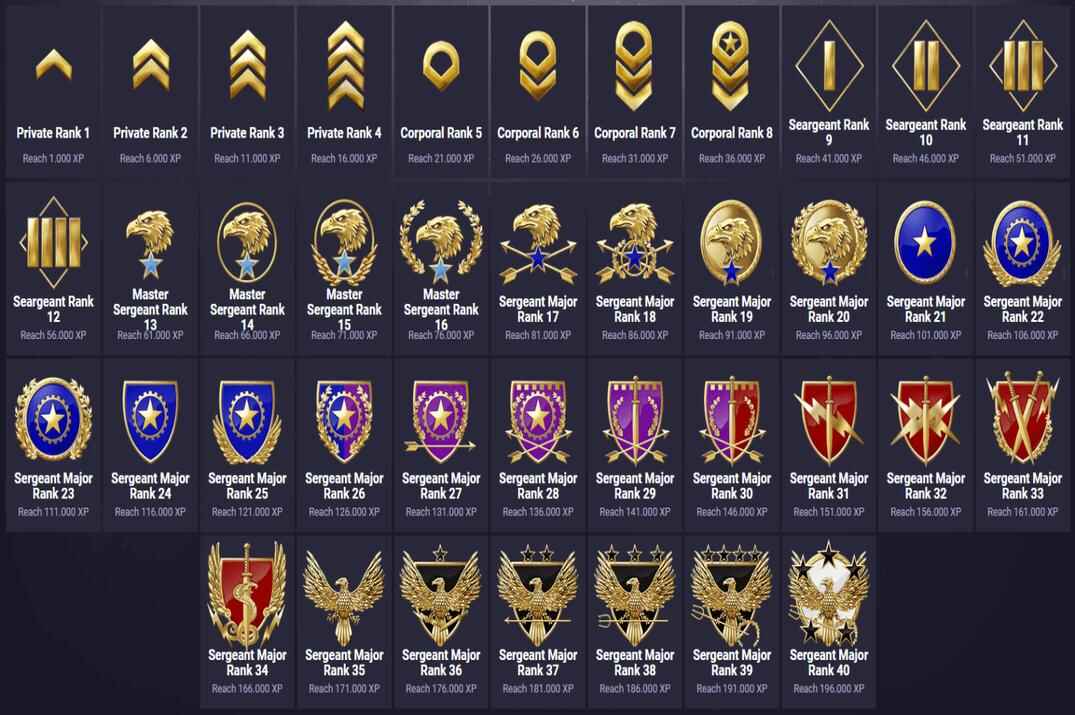
Valve added profile levels in May 2015, with Operation Bloodhound. Forty ranks, Private 1 up to Global General 40, each one costing 5,000 XP - about 195,000 for the full climb.
Profile Rank does not measure matchmaking skill. Your level shows how much XP you have earned, not how well you play. Its main practical function is gating: Level 2 for Competitive and Level 10 for Premier.
How XP works
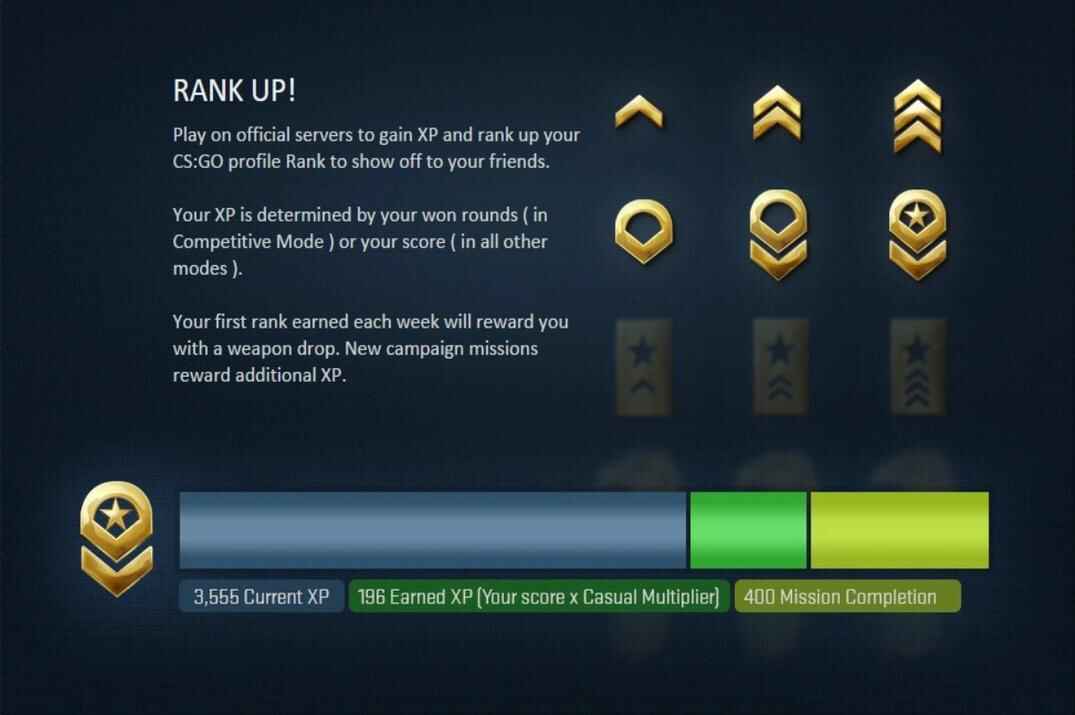
Prime players earn XP in official game modes. In Competitive and Premier it is 30 XP per round won. Deathmatch pays score multiplied by 0.2. Casual, Wingman and other modes use their own formulas, all feeding the same Profile Rank.
The multiplier is where it gets interesting. It resets to full at the start of each week and drops as you earn:
| XP earned this week | Multiplier |
|---|---|
| up to ~4,500 | ×4 |
| ~4,500 – 7,500 | ×2 |
| ~7,500 – 11,167 | ×1 |
| past ~11,167 | ×0.175 |
That last row is usually called XP overload, and a lightning bolt appears next to your name when you hit it. At that point, even a full Premier win can give less XP than a single round did at the start of the week.
It means that XP is earned much faster early in the week. Once you reach reduced XP, further matches give very little until the weekly reset.
Service Medals
Hit Rank 40 and a button appears offering to reset you back to Private 1 in exchange for that year's Service Medal. Take it and the medal goes in your inventory permanently.
Resetting costs you nothing else. Your CS Rating, your Competitive badges and your Prime status are untouched - and you do not lose access to anything, despite the Level 2 requirement you technically just dropped below.
Do it again in the same calendar year and the medal upgrades a colour instead of giving you a second one:
| Resets | Colour |
|---|---|
| 1 | Grey |
| 2 | Green |
| 3 | Blue |
| 4 | Purple |
| 5 | Pink |
| 6 | Red |
Each year gets its own design, released on 1 January and available until the end of December. The shape stays the same across all six tiers - only the colour changes.
The red medal

Six resets in one year. That is 240 levels, roughly 1.2 million XP, against a weekly ceiling that drops you to ×0.175 after 11,167. Run the numbers and it comes out at most of a year spent playing most of every day.
Which is why red medals are rare and why people assume bots whenever they see one. Green and blue are what regular players finish a year on. Purple and pink mean someone genuinely played a lot.
The medal does nothing in a match. It is a receipt for time spent, and that is the entire appeal - it is the one thing on a CS2 profile that cannot be bought.
More CS2 Resources
Where to go once you know what the number means.

CS2 Guides
Settings, mechanics, performance, gameplay systems and general CS2 guides.
open →
Maps & Callouts
All fifteen, with callouts and what each side is trying to do on them. Start with the Premier seven.
open →
Weapons
Damage per hitbox, spray patterns, prices and what each gun is worth on a given buy.
open →
Scripting & Binds
Buy binds, grenade binds and the aliases that save a few seconds every round.
open →
Steam ID Explained
The identifiers behind every profile, and how the formats convert into each other.
open →
Back to CS2 Hub
Tools, tests, pro settings, skins and everything else in the CS2 section.
open →