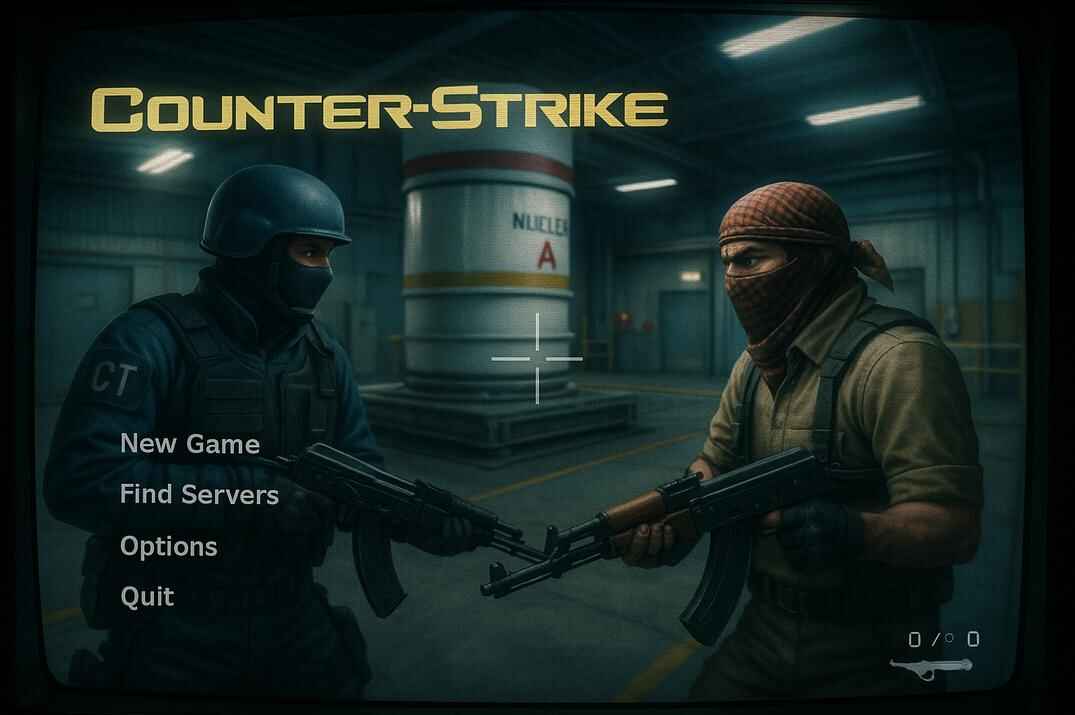
History of Counter-Strike 1.6

Table of Contents

Introduction

Counter-Strike 1.6 is a multiplayer tactical first-person shooter developed by Valve on the GoldSrc engine and released in 2003 alongside the launch of Steam. The game represents one of the most important chapters in CS 1.6 history, marking the final major version of the classic Counter-Strike era built around precise gunplay, fast reaction-based mechanics, and a strong focus on competitive skill.

The game laid the groundwork for early esports and directly influenced later titles such as CS: Source, CS:GO, and Counter-Strike 2. Unlike modern versions, CS 1.6 relied almost entirely on player mechanics rather than progression systems or unlocks. Decades after its release, it remains actively played thanks to its responsiveness, deep mod support, community-driven servers, and extremely low system requirements.

From Quake Mods to Counter-Strike 1.6

The history of Counter-Strike did not begin as a standalone game. Its roots trace back to the late 1990s modding scene, where experimentation, community creativity, and competitive ideas slowly shaped what would become one of the most influential shooters ever made. From early Quake mods to the release of CS 1.6, this period defined the core mechanics, philosophy, and competitive identity of Counter-Strike.

Chronology in Brief

Year Milestone
1996 Release of Quake - a breakthrough for online FPS and early esports
1997 Gooseman creates Navy SEALs, a Quake mod - the spiritual ancestor of CS
1998 Development shifts to the Half-Life engine
1999 Counter-Strike Beta 1.0 is released to the public
2000 Valve acquires Counter-Strike and launches version 1.0
2001-2002 Rapid development - versions 1.1 to 1.5
2003 CS 1.6 officially launches via Steam
2003-2012 The era of CS 1.6 in professional esports
2013+ Community-driven content, mods, and unofficial updates keep the game alive

Early Roots: Quake and the Birth of eSports

It all started with Quake (1996) - the groundbreaking shooter that laid the foundation for modern online competitive gaming. For the first time, a fast-paced FPS offered a true online multiplayer experience, paving the way for everything that would follow.

In 1997, a legendary moment in gaming history took place: Dennis "Thresh" Fong won the Red Annihilation tournament in Quake, taking home a Ferrarix 328 GTS previously owned by John Carmack, one of the game’s creators. It wasn’t just a flashy prize - it symbolized the birth of real, high-stakes competition in gaming. It demonstrated that competitive gaming could exist at a professional level.

Quake’s fast movement, high skill ceiling, and modding tools helped spawn a new era - one that would eventually lead to Counter-Strike and beyond.

Minh Le’s First Mods and the Idea of Counter-Strike

Amid the Quake modding boom, a talented student from Canada - Minh "Gooseman" Le - began to make a name for himself. As a teenager, he started experimenting with game modding using tools provided by id Software, creating content for both Doom and Quake.

In 1997, at just 18 years old, Minh developed a mod called Navy SEALs for Quake - a military-themed project that became a spiritual prototype for Counter-Strike. While it never became widely popular, it introduced early concepts that would later define CS: special forces vs. terrorists, tactical gameplay, and realistic weapons.

According to Minh, a huge inspiration came from the 1995 film Heat starring Al Pacino and Robert De Niro - its intense urban shootout scenes influenced both weapon choices and the grounded tone of the gameplay.

Minh’s skills quickly grew. He joined the team behind Action Quake 2, creating weapon models for The A-Team, the group developing that mod. Action Quake, known for its fast-paced gunfights inspired by Hong Kong cinema, helped refine Gooseman’s style and vision.

During this period, Minh met Jess "Cliffe" Cliffe, a web designer and fellow modding enthusiast. They decided to collaborate on a new project - one that would combine tactical team-based gameplay with realism. When Half-Life was released in 1998, Minh was impressed by its engine (GoldSrc - based on id Tech 2 but with major improvements like skeletal animation). He knew it was the perfect platform for what he envisioned.

Before Valve even released the official SDK for modding, Minh began designing models and assets. The duo called themselves the Counter-Strike Team: Minh handled coding and 3D modeling, while Cliffe focused on level design, 2D art, sound, and community outreach.

That’s how the idea of Counter-Strike began to take shape - long before anyone realized it would become a gaming phenomenon.

Valve Acquires Counter-Strike: Version 1.0 Is Released

By the time CS Beta 3.0 was making waves, Valve had taken notice. In early 2000, they officially approached Minh Le and Jess Cliffe with an offer: full support, a proper development deal, and jobs at the company. The team accepted - and that spring, Valve announced it had acquired the rights to Counter-Strike. Version 1.0 would become part of an upcoming update for Half-Life.

After the final beta patches (versions 6.5 and 7.0), the game was ready for full release. On November 8, 2000, Counter-Strike 1.0 launched - both as a free mod (titled Half-Life: Counter-Strike) and as a boxed retail edition published by Sierra. The retail version included three new weapons, a training map, and improved character models created by Valve.

The transition to Valve brought CS to the next level. The overall polish improved, legal concerns were resolved (for example, real weapon names were replaced with fictional ones), and the game’s audience exploded. By the end of 2000, Counter-Strike had overtaken both Team Fortress Classic and Unreal Tournament in popularity - boasting hundreds of thousands of players across thousands of active servers worldwide.

Steam Launches and Version 1.6 Released

In 2002, Valve was preparing to launch its own digital distribution platform - Steam - and chose Counter-Strike as one of the first games to test it. In October that year, the studio announced that the upcoming CS 1.6 would be distributed exclusively through Steam. The public beta was originally set for November, but after several delays, it finally began on January 16, 2003.

The demand was massive. On day one, Steam’s servers struggled to handle the traffic, and new registrations were briefly suspended. But the beta moved forward - and by summer 2003, testing opened up to everyone.

Version 1.6 introduced several major changes. It added two new weapons - the Galil (for terrorists) and the FAMAS (for counter-terrorists). A brand-new interface based on VGUI2 improved the game’s menus and HUD.

Valve also used the beta as an opportunity to test official bots - AI opponents created by Turtle Rock Studios, who were working on the upcoming Counter-Strike: Condition Zero. Starting in June 2003, these bots were included in the CS 1.6 beta for live feedback and refinement.

After more than half a year of testing, the final version of Counter-Strike 1.6 launched on September 12, 2003, alongside the official release of the Steam client. From that point on, updates were delivered digitally, and all players were required to use Steam to access the game.

A new version 1.6 marked a new chapter for Counter-Strike. It brought fresh content and introduced the world to a new way of distributing and updating games - digitally, through Steam.

Counter-Strike Version Timeline (1999-2003)

Between 1999 and 2003, Counter-Strike went through its most intense period of evolution. What began as an experimental mod rapidly transformed into a structured competitive game through frequent beta updates and major gameplay changes. This timeline highlights the key versions that shaped Counter-Strike’s mechanics, balance, and identity, leading up to the release of CS 1.6.

Evolution of the Mod (Beta 1.0 - 7.1)

The early beta versions of Counter-Strike defined the core mechanics of the game. Each one brought new mechanics, weapons, maps, and ideas that shaped what would become CS 1.6. Here’s a breakdown of how the mod evolved during its first year of development.

Beta 1.0 - June 19, 1999

The very first public beta. It included four hostage rescue maps (cs_prison, cs_mansion, cs_siege, cs_wpndepot) and a limited arsenal of nine weapons shared between both teams - including the USP, Glock 18, M4A1 (with fixed scope), AWP, MP5, and more. Flashbangs were already present and could be "cooked" for instant detonation. Dead players’ weapons remained on the ground, and each team had only one character model: Irish Republican Army (IRA) (T side) and SEAL Team 6 (CT side). Despite its simplicity, this beta was explosive in popularity.

Beta 1.1 - 1.2

New maps like cs_assault and cs_desert were added. The Glock 18 got a burst-fire mode. Friendly fire became an optional setting, and the economy system began to take shape. Freeze-time was introduced to stop rushes at round start and give players time to buy. A cash limit of $16,000 was implemented. The armor system was improved and jumping accuracy reduced.

Beta 2.0 - 2.1

This update brought in the AK-47, SG-552 Commando, and Desert Eagle. Silencers were introduced for the USP and M4A1. Night vision was added but later removed due to poor visibility. The UI improved with round timers and kill scoreboards. Players could now drop weapons.

Beta 3.0 - 3.1

Major gameplay features appeared: the knife was introduced, and the FN P90 joined the weapon roster. New models for GSG-9 and Elite Crew were added. The first radio commands like “Stick together, team!” made their debut. A new concussion grenade replaced the flashbang but caused debate due to its lethal shrapnel. By 3.1, its damage was reduced and audio cues improved.

Beta 4.0 - 4.1

A game-changer. This version introduced the now-iconic bomb defusal mode (de_dust, de_nuke, de_prodigy) alongside a new HE grenade and a simplified ammo system (primary/secondary instead of unique per gun). Scout and P228 were added. Teams earned more money after losing a round to balance comeback potential. Flashbangs were nerfed. Players could finally recover dropped bombs and get rewarded for escorting hostages.

Beta 5.0 - 5.2

A huge collaboration with Barking Dog Studios. New weapons: Benelli XM1014, updated models, and new maps (cs_backalley, cs_iraq, de_train). The C4 became an actual inventory item, with planting and defusing reworked into timed actions. For the first time, players could pass the bomb to others. Observer modes were introduced - free camera, chase cam, and ghost mode. Dead players could now spectate teammates.

Beta 6.0 - 6.2

Several new maps and game modes were introduced: Assassination (as_) and Escape (es_). The MAC-10, AUG, and updated MP5 arrived. Players could switch between left- and right-hand weapon view. Arctic Avengers and GIGN models were added. The radar appeared, and radio commands expanded. The gameplay became more technical, with movement tweaks and weapon rebalancing.

Beta 6.5 - 6.8

Valve’s new netcode was integrated for better performance. Smoke grenades made their debut, as did fan-favorite maps like cs_italy, de_cbble, and de_aztec. The vote system for maps (listmaps / votemap) was added. M4A1 and USP now had attachable/removable silencers - a major detail. Multiple bugs and exploits were fixed in quick server-side updates.

Beta 7.0 - 7.1

The final beta series before the full release. Dual Berettas were introduced, along with updated knife mechanics (stab vs slash), improved VGUI menus, and new models (SEAL Team 6, VIP). Maps like cs_office, de_vegas, and cs_arabstreets were added. The devs even tested driveable vehicles on a novelty map de_jeepathon2000. Beta 7.1 included HUD icons for headshots and made final balance tweaks before version 1.0 dropped later that year.

Evolution of the Mod (Retail 1.0 - 1.6)

Version 1.0 - November 8, 2000

The first full retail release of Counter-Strike, launched as both a Half-Life mod and a boxed edition. New weapons were introduced: UMP45, FN Five-Seven, and SG-550. All player and weapon models were rebuilt using skeletal animation for smoother movement. A new training map was added, while older maps like Arabstreets, Foption, and Estate were removed. Terrorist factions were renamed to Phoenix Connexion and Guerilla Warfare. Real weapon names were replaced with fictional ones for legal reasons.

Version 1.0b - January 25, 2001

The first server-side patch. Fixed client lag during map load, repaired the listmaps command, and improved overall server stability.

Version 1.1 - March 13, 2001

A major update for both retail and mod versions. Introduced new maps: cs_thunder, de_vertigo, de_inferno, de_dust2, de_rotterdam. Added spectator mode. Jumping accuracy was nerfed, especially for SMGs. The AWP could no longer kill with a leg shot (1 HP left instead). Bomb and defuse kit icons returned to the HUD. Models were upgraded with 512×512 textures and swim animations. Map cycling and hitboxes were also improved.

Version 1.1c - April 6, 2001

Another server patch. Focused on performance and stability. No client changes.

Version 1.2 - June 30, 2001

Engine-side update for the retail version. Fixed bugs and improved performance. No changes to gameplay.

Version 1.3 - September 12, 2001

A game-wide update (mod + retail). Added built-in voice chat, plus new maps: de_torn, de_storm, de_survivor. Removed de_rotterdam and cs_thunder. Bunny hopping was nerfed again (reduced air momentum). Communication and teamplay became more tactical - this version pushed CS further into competitive territory.

Version 1.4 - April 24, 2002

New maps: cs_havana and de_chateau. Introduced the first version of Valve Anti-Cheat (VAC). First-person view added to spectator mode. Another bunny hop nerf. Dead bodies stayed until round end. Players couldn’t move while planting/defusing. CTs no longer saw bomb notifications. Enemy radio commands became team-only. New config option: cl_autowepswitch. HLTV was improved with a better interface and features. Radar now showed who was speaking and the bomb’s position.

Version 1.5 - June 12, 2002

The final major update before the transition to Steam. Added the map de_piranesi. Fixed multiple bugs. Many iconic tournaments of the early 2000s were played on this version. It’s widely considered the most polished "pre-Steam" build of Counter-Strike.

Version 1.6 - September 9, 2003

The final classic version of CS - now exclusively on Steam. Support for WON servers was dropped. New weapons: Galil (T), FAMAS (CT), and the Ballistic Shield. Map de_airstrip was added. Skin support was introduced via Steam, along with numerous engine-level improvements. Version 1.6 would go on to define competitive CS for years to come.

Game Modes in CS 1.6

Although Counter-Strike 1.6 is known for its strict competitive format, it actually supports several distinct game modes - each with its own objectives, pacing, and playstyle. Some were official, others came from the modding community, but all of them added depth and variety to the game.

Hostage Rescue (cs_)

In this mode, counter-terrorists must rescue hostages and bring them to a safe zone. Terrorists try to stop them - either by guarding the hostages or eliminating the CTs.

While the idea is noble, in practice this mode often turned into pure gunfights, with hostages completely ignored. Still, maps like cs_assault, cs_office, and cs_italy became iconic. Everyone remembers pushing through the warehouse in Assault, or trading shots across the courtyard in Italy. The mode had its flaws, but also gave us some of the most memorable public server moments.

Bomb Defusal (de_)

Bomb Defusal became the core competitive mode of Counter-Strike and the standard for professional play. Terrorists plant the bomb, CTs try to stop them or defuse it.

If the bomb isn’t planted, CTs win by timeout or elimination. Once the bomb goes down - it’s all about positioning, timing, and nerves. Classic maps like de_dust2, de_inferno, de_nuke, and de_train were built around this mode, and every serious match was played on them. Bomb defusal became the standard for competitive CS.

Assassination - VIP (as_)

Here, one CT becomes the VIP - armed only with a pistol and extra armor. The rest of the team must escort him to an extraction point while terrorists try to hunt him down.

It was a great concept, but in reality, the mode was unbalanced and rarely played in matches. Still, maps like as_oilrig and as_tundra had their fanbase, especially among players looking for something different. A mode with potential - but one that never quite took off.

Deathmatch / Team Deathmatch (DM)

No bomb, no hostages, no objectives - just pure action. Kill as many as you can, respawn instantly, repeat.

Deathmatch became a staple on community servers. It was perfect for warming up, practicing aim, or just relaxing after a stressful match. Some players knew it as "relax mode" - no tactics, just frags.

GunGame (GG)

Start with a basic weapon, get a new one with every kill, and finish the match with a knife. Simple, chaotic, and insanely fun.

GunGame turned CS into an arcade experience. Fast rounds, unpredictable outcomes, and constant pressure. The mode became so popular that it was later included in CS: Source and CS:GO as Arms Race.

Zombie Mode (ZM)

One or more players start as zombies. Everyone else must survive - or be infected.

Zombies have tons of health and attack in melee. Humans can build barricades, defend choke points, and buy special weapons. Zombie servers were - dark maps, custom skins, creepy sounds, and endless waves. The mode lives on to this day and has its own subculture inside CS.

JailBreak

CTs act as prison guards. Terrorists are inmates. The round is part FPS, part roleplay.

Sometimes the CTs organize mini-games, sometimes the prisoners riot. JailBreak servers developed their own rules, slang, and drama. For many, it was less about shooting and more about playing a social meta-game inside CS. Creative chaos at its finest.

Surf / Kreedz / Fun Modes

Not all CS maps are about combat. Some are about movement.

Surf maps let players glide on angled ramps at high speed, like snowboarding with guns. KZ (Kreedz Climbing) maps challenge players to jump through precise obstacle courses. HNS (Hide and Seek) is about running, hiding, and chasing across creative arenas.

These modes trained a generation of players in movement control - and later inspired mechanics in CS:GO and other games.

Legendary Maps in CS 1.6

Counter-Strike 1.6 would never have reached cult status without the maps we all grew up on. These levels were more than just places to shoot - they shaped the very language of CS, defined how players think about positioning, and even sparked an entire subculture. What’s especially remarkable is that most of them weren’t made by Valve. They came from the community - crafted by enthusiasts who gave us the iconic battlefields we still remember.

Map Dust2 (de_dust2)

Player holding a knife on the de_dust2 bombsite in Counter-Strike 1.6
The site A on the Dust2 Map

The symbol of Counter-Strike. Created in 2001, Dust2 appeared in version CS 1.1 and was part of the bomb defusal mode. It quickly became the visual and tactical icon of the entire series. Its simple, intuitive layout allowed for deep strategies - both teams knew what to do in any given situation. Phrases like "rush B" and "hold long" became memes before the word "meme" even existed.

Dust2 was featured in nearly every tournament and was loved by pros and casual players alike. It’s still part of the CS2 map pool - and that says it all.

Map Nuke (de_nuke)

Outdoor area of de_nuke with multiple players in a Counter-Strike 1.6 match
The "Outside" callout on the Nuke

First introduced in 1999 during Beta 4, Nuke stood out thanks to its multi-level structure - one bombsite above, one below. This kind of vertical gameplay required serious team coordination and a strong understanding of movement routes.

One of the most important zones was "outside" - a long open stretch perfect for long-range fights and snipers. Nuke has always been known as one of the most "tactical" maps in CS. It rewarded brains over raw aim, and in CS2 it remains a map for thinkers.

Map Inferno (de_inferno)

Classic de_inferno map in Counter-Strike 1.6 showing apartments and middle area
Classic Inferno showing the "Banan" area

A true classic of urban combat. Added in 2000 (Beta 6.5), Inferno featured tight choke points, tricky angles, and a layout perfect for tactical grenades. Every second mattered. Every flash, every smoke could change the outcome of a round.

Inferno was where some of the most dramatic clutches and comebacks happened. It demanded solid timing and smart use of utility. The CS2 version remains almost untouched - a sign of just how timeless its design really is.

Map Train (de_train)

Rail yard and bombsite view from de_train in Counter-Strike 1.6
Bombsite B on the Train

Train appeared in Beta 7 (2000) and quickly became a proving ground for serious players. With its long sightlines, tight angles, and cluttered layout, it was a sniper’s paradise and a masterclass in positional play.

On Train, sound mattered. One footstep out of place could give away a flank. One misstep could cost your team an entire site. It’s one of CS’s most unforgiving maps - but also one of the best for honing both individual and team skill.

Map Italy (cs_italy)

Mediterranean village scene from cs_italy in Counter-Strike 1.6
CT respawn on the Italy

Set in tight alleyways and small courtyards, Italy debuted in 2000 and quickly became the most beloved hostage rescue map. It was never meant for pro play, but on public servers it reigned supreme.

Everyone remembers Italy - from the kitchen to the balcony. It taught new players how to feel the map and navigate a dense urban layout. Though it was a bit CT-unfriendly in 1.6, the CS2 version balanced things out. For many, Italy was their first taste of CS.

Map Aztec (de_aztec)

Rain-soaked ancient ruins of de_aztec in Counter-Strike 1.6
Bombsite A on the Aztec

Aztec appeared back in Beta 4 (1999) and brought players into an environment unlike any other - flooded ruins, stone bridges, and long open corridors. It favored fast pushes and sniping, especially over the central bridge and through the tunnels.

Despite the exotic visuals, the map had a solid structure and surprisingly balanced gameplay. Many consider CS2 Ancient to be Aztec’s spiritual successor - both in style and pacing.

Map Assault (cs_assault)

Hostage rescue scenario in cs_assault from Counter-Strike 1.6
Assault - outsite overview

Warehouse warfare at its purest. Assault was one of the first CS maps, dating all the way back to Beta 1 (1999). The setup was simple: CTs storm a building where terrorists are holding hostages. But the execution? Wildly variable.

The map saw many visual updates, but the concept stayed the same: breach or hold. In 1.6, T side had a slight edge, especially in closed matches. But for many, this was the first map where they learned what teamwork really means - and what tactics look like in a shooter.

CS 1.6 Mods and Server Plugins

The foundation was laid by the developers - but it was the community that truly brought Counter-Strike 1.6 to life. Thousands of players, admins, and enthusiasts transformed the game from a classic shooter into a flexible platform where you could play anything: zombie apocalypse, RPG leveling, superpowers, GunGame, magic, or even Warcraft battles. This is where it all began - GunGame, WarCraft, Zombie Plague - mods that went on to become popular in their own right.

Metamod and AMX Mod X - The Engine Behind All Modding

Metamod was the original hook - the tool that allowed plugin support on servers and kicked off the age of CS modding. Later came AMX Mod X, a more powerful and flexible system that still runs most public servers to this day.

AMX Mod X supports thousands of plugins. Admins can use full control panels, launch votes, customize HUD and chat, add kill sounds, and manage in-game stats through databases.

Admins and VIPs

Admins in CS 1.6 weren’t just moderators - they were demigods. With the help of plugins, they had total control over the game. They could blind players, set them on fire, drop an AWP, revive teammates, or teleport anyone anywhere. Sometimes they’d even host small events: duels, knife-only rounds, or limited weapon matches.

And that hasn’t really changed. Today’s admins still shape the mood of a server and keep the order.

Sure, some of them let the power go to their heads - it happened. But more often, the admin was the heart of the community. They resolved conflicts, banned cheaters, brought in regulars, and kept public servers alive. I remember using the rare but super handy command mp_swapteams 1 more than once - especially on cs_assault or cs_italy, when T-side was dominating +10 rounds in a row. It helped keep things fair.

Many servers had VIP systems - players could earn perks through donations, high activity, or by topping the monthly scoreboard. Typical VIP bonuses included starting with any weapon, extra health, or getting HP for every kill. Being top frag didn’t just feel good - it often meant a reserved slot and bragging rights.

Customization: Skins, Models, Sounds, HUDs

There was never official skin support in CS 1.6 - but that didn’t stop the community from changing everything. Popular servers still run golden AKs, neon AWPs, anime character models, and custom sound packs from Half-Life, Duke Nukem, or Mortal Kombat. Flashbangs can explode with skull smoke. HUDs can be rainbow-colored. It’s all still happening.

And no manual downloads needed. Just join the server - and in seconds, you’re in a completely new visual and audio environment. No mod installers, no restarts - everything you need is pushed to you automatically when you connect.

Unlike CS2, everything in CS 1.6 can be replaced. Players can install custom skins and models for themselves, their teammates, or even the enemy team. It’s complete freedom - and that’s part of the magic.

How Modding Changed the Game

Mods didn’t just expand the game - they redefined what CS could be. With custom servers and plugins, every match felt different. Some servers ran RPGs with levels and quests. Others built small clan communities with custom ranks and private leagues.

CS 1.6 became social. Players made friends, joined teams, argued on forums, grew up together. Some learned to work with SQL and servers. Others wrote their first lines of code thanks to AMX scripting. For many, modding was a gateway into IT, game dev, or community management.

While other games relied on developer updates, CS 1.6 evolved because of its players. That’s why it’s still alive.

CS 1.6 Esports Era (2001-2012)

In the early 2000s, the word "esports" still sounded strange - almost futuristic. But it was Counter-Strike 1.6 that turned it into reality. It wasn’t just a shooter you played in LAN cafes - it was a proving ground where true competition began to take shape, where clans were born, and matches were won not just with aim, but with tactics.

This was before Twitch, Discord, and YouTube. Everything happened live - in clubs, at local tournaments, with USB sticks in your backpack and your keyboard in a plastic bag. CS 1.6 was the first game people didn’t just play for fun - they played it to win.

Tournaments That Changed Everything

CS 1.6 was the first game to create a real global esports ecosystem. Tournaments, broadcasts, shoutcasters, and fans - it all started here.

CPL (Cyberathlete Professional League) was the spark. Founded in 1997, it began hosting serious CS tournaments by 2000. CPL Summer and Winter events in Dallas became legendary. Winning there wasn’t just a trophy - it was global recognition. The CPL World Tour in 2005 hit countries like the U.S., Brazil, Germany, Singapore - and brought together the world’s best teams.

Then came WCG (World Cyber Games) - the "Olympics of esports". Teams represented their countries, fought through brutal qualifiers, and stood under national flags. In places like South Korea, the WCG finals aired on national TV. Winning WCG gold was esports gold - literally.

Meanwhile in France, ESWC (Electronic Sports World Cup) emerged - a European response to WCG with unmatched production value. This was a real show - bright ceremonies, fireworks, show matches, and fierce rivalries between France, Sweden, Poland, and Russia. It wasn’t just a LAN - it was a spectacle.

Later came IEM (Intel Extreme Masters) - the one that changed everything again. Launched in 2006 with Intel and ESL, IEM made CS 1.6 its flagship title. It was here we saw the first top-tier productions - full studios, cameras, replays, casters. Finals were held at CeBIT in Hanover, then at IEM Katowice and IEM Cologne - not just tournaments, but full-scale esports festivals. IEM brought prestige. It gave esports a new face.

Teams That Became Legends

Every golden era has its champions - and CS 1.6 had more than a few. These weren’t just tags on a scoreboard - they were playstyles, philosophies, entire schools of Counter-Strike.

NiP (Ninjas in Pyjamas) from Sweden set the gold standard for structure and teamplay. A well-oiled machine where every player knew their role. The first true dynasty.

SK Gaming started as German giants, then evolved into Swedish dominance. Their CPL performances became part of CS legend.

mTw, the tactical masterminds from Denmark, showed the world that strategy wasn’t just about throwing a flash - it was an entire system of victory.

fnatic brought the fire - aggression, precision, raw pace. They forced every opponent to play their tempo.

Virtus.pro, the pride of the CIS scene, came up from dusty LAN cafes and became a force. Their games had everything - comebacks, chaos, emotion.

The Legacy of Counter-Strike 1.6

Counter-Strike 1.6 was more than just another version of the game. It marked the point where Counter-Strike fully established its identity and influence, shaping how competitive shooters would be played, organized, and experienced for years to come.

By the time version 1.6 was released, Counter-Strike had already become a global phenomenon. However, this update was not simply an incremental step forward. It refined the game into its most complete classic form, combining precise mechanics, clear rules, and a skill-driven structure that set it apart from other shooters of its era.

The community ecosystem around CS 1.6 expanded rapidly. Numerous community mods appeared, including Zombie modes, GunGame, Surf maps, and Kreedz climbing challenges. Servers operated both officially and outside of Steam, often running custom plugins, background music, detailed statistics, and RPG-style systems. Internet cafés around the world regularly hosted local CS 1.6 servers, and long overnight sessions frequently ended with a final round on de_dust2 or a tense hostage rescue on cs_office.

In esports, CS 1.6 became the primary competitive platform of its time. Major tournaments such as WCG, CPL, ESWC, and IEM defined professional standards, shaped team identities, and helped establish Counter-Strike as a serious competitive discipline. During this era, players began treating the game as a profession, while spectators followed matches with the same passion seen in traditional sports.

Even after the release of CS: Source, CS:GO, and CS2, many players continue to view version 1.6 as the purest expression of Counter-Strike. Its minimalism, transparent mechanics, and steep learning curve remain a benchmark that developers and modders still attempt to replicate.

Conclusion

Counter-Strike 1.6 is more than the final version of an early mod. It demonstrated that a global competitive game does not require massive budgets or cutting-edge visuals. Instead, clear mechanics, balanced gameplay, openness to community modifications, and strong player involvement were enough to build something lasting. Even decades later, CS 1.6 remains a reference point for tactical shooters and the foundation on which CS:GO and Counter-Strike 2 were built.

F.A.Q.

A glowing 'FAQ' displayed on a futuristic holographic panel, surrounded by floating question marks and digital circuitry within a cosmic, sci-fi environment
What’s the difference between CS 1.5 and CS 1.6?

The main differences include the transition from the old WON network to Steam, the addition of the FAMAS and Galil rifles, the introduction of the ballistic shield, and major engine, UI, and networking updates.

Who voiced the in-game radio commands?

Most of the iconic radio commands ("Fire in the hole!", "Go, go, go!") were recorded by Counter-Strike co-creator Jess Cliffe.

Is Counter-Strike 1.6 still active today?

Yes. Valve continues to release occasional technical updates for the Steam version (the latest in December 2023), and thousands of community servers remain active worldwide.

What engine does CS 1.6 run on?

CS 1.6 runs on the GoldSrc engine, a heavily modified version of id Software’s Quake engine.

Was CS 1.6 ever free to play?

No. While early versions were distributed as mods, CS 1.6 has always required ownership of Half-Life or a standalone purchase via Steam.

Does CS 1.6 support mods and custom servers?

Yes. CS 1.6 has extensive modding support through tools like Metamod and AMX Mod X, allowing servers to run custom game modes, plugins, and configurations.

Can CS 1.6 run on modern computers?

Absolutely. Thanks to its very low system requirements, CS 1.6 runs smoothly on almost any modern or older PC.
Continue Reading

Counter-Strike 1.6 config illustration showing console with commands bind, rate, fps_max, and exec userconfig.cfg, styled on a Dust2-inspired background with HUD elements
Counter-Strike 1.6 Config Guide – Commands and Optimization

Counter-Strike 1.6 Config Guide – Commands and Optimization Table of Contents Introduction A Counter-Strike 1.6 config is simply a plain-text file with CS 1.6 config commands and settings that the game reads and applies. Instead of clicking through menus every time, you write the exact values you want – key

Read More
Leave a Reply

Your email address will not be published. Required fields are marked *