What the CS2 AK-47 Script Does

This script uses at least two config files to replay a predefined AK-47 recoil compensation pattern. It doesn’t touch the game’s code, read memory, or alter weapon behavior. Everything is done through native developer console commands and the way Source 2 executes config files.
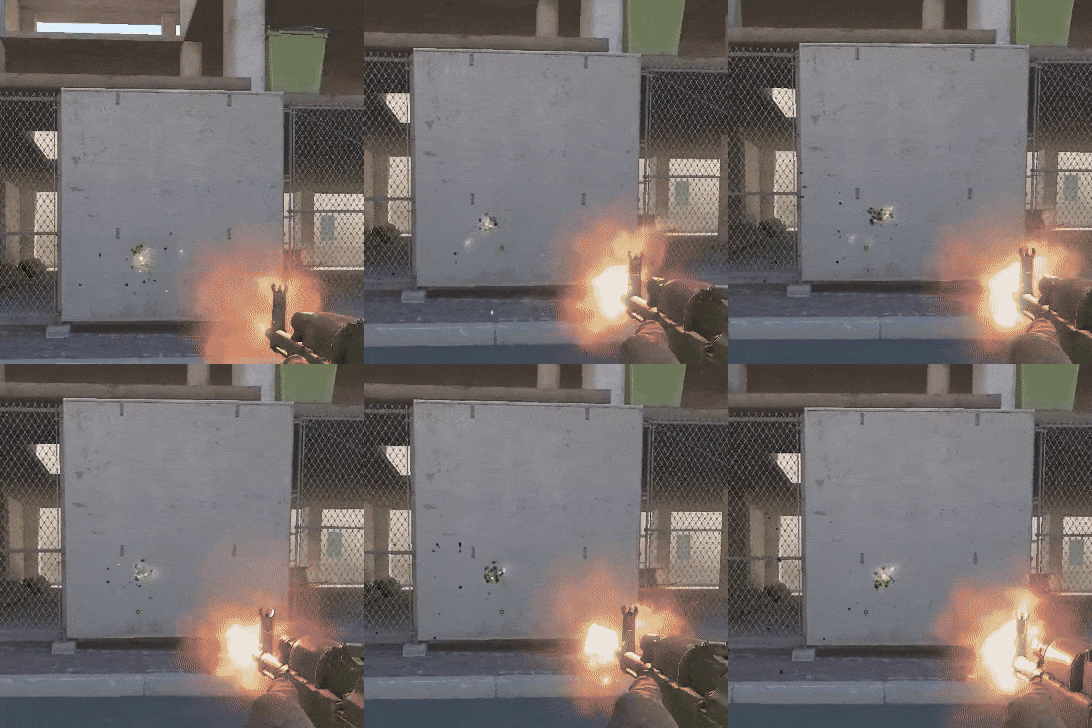
The idea is straightforward: the AK-47 recoil pattern is predictable, so it can be countered with a pre-calculated camera movement. Instead of reacting on the fly, the script plays a sequence of tiny corrections that line up with each shot in the spray.
In other words, it replays an ideal anti-recoil pattern step by step, on a fixed schedule. That makes it easy to see what stable recoil control looks like without the human factor - no reaction delay, no hand jitter, no inconsistent mouse pull.
Timing is the whole point. Compensation only works when each camera adjustment happens at the right moment, synced with the rate of fire. Even a small shift - too early or too late - breaks the trajectory and the pattern falls apart.
That’s why repeatability matters: consistent intervals, consistent execution, and controlled conditions. Unlike a player, who introduces small variations every spray, the script produces the same sequence every time - which is exactly what makes it useful for training and analysis.
What the Script Is Used For in Training
The main purpose of a script like this is learning, not competitive play. In a practice environment, it works as a visual reference: you can watch how the camera should move during a full spray and compare it to your own manual recoil control.
It’s also popular simply as a technical experiment. On local or private servers, it lets you observe near-ideal weapon behavior and compare it to real gameplay - not as an advantage, but as a way to explore how Counter-Strike 2 works under the hood.
Internal Mechanics of the AK-47 Anti-Recoil Script
At the core of any script like this are two things: command automation and timing. The anti-recoil setup is built around at least two files - the main script itself (ak47.cfg) and a separate file (loop.cfg) that handles timed, asynchronous execution. To understand why this approach works in CS2, it helps to look at how the wait and exec commands evolved over time.
Delay: From wait to sleep
The wait command is the foundation of scripting in Counter-Strike 1.6. It pauses script execution for exactly one frame, creating the delay needed between actions. In more complex macros - running, shooting, jumping - this pause is essential, because it gives the engine time to process each command separately. If multiple actions are executed on the same line without wait, the engine simply won’t register them correctly, and only the first action may take effect.
The problem is that in CS 1.6, frame duration depends directly on FPS (CS 1.6). At 100 FPS, a single wait lasts roughly 10 ms. At 20 FPS, that same wait stretches to about 50 ms. As a result, script timing varies wildly between systems, completely breaking consistency.
The sleep command introduced in Counter-Strike 2 solves this limitation. It works on real time instead of frames, using milliseconds. A sleep 10 delay is always 10 ms, and sleep 100 is always 100 ms - regardless of FPS (CS2). This makes script timing stable, predictable, and independent of system performance.
Asynchronous Execution: From exec to exec_async
The standard exec command is designed to load configuration files sequentially. When you run exec config.cfg, the engine reads the file from top to bottom and attempts to execute all commands immediately. Because of this, traditional config files don’t really exist over time - they execute in a single burst rather than alongside gameplay.
If a config is large (1,000+ lines), this can cause noticeable performance drops until execution finishes. Trying to run a loop through exec is even worse: the game will almost certainly freeze, because there’s no way to interrupt execution. The main game thread becomes fully occupied by the script.
The exec_async command introduced in Counter-Strike 2 works differently. It runs the specified config file in a separate background thread, without blocking the main game loop. Even configs with tens of thousands of lines can execute smoothly, without freezes or FPS loss, because command execution happens in parallel with gameplay.
In practice, exec_async turns the console from a simple command interpreter into a powerful automation tool - one that can run, manage, and control long-lived scripts and loops without hurting performance.
Quick Comparison Table
| Command | Behavior |
|---|---|
wait |
Waits for a frame, not real time |
sleep |
Waits for a fixed time (milliseconds) |
exec |
Sequential execution |
exec_async |
Parallel, background execution |
AK-47 Script Breakdown
Below is a simplified example of the ak47.cfg file used in this setup. It may look intimidating at first, but the logic behind it is straightforward once you understand how the aliases interact.
fps_max 125; sv_cheats 1; exec_async loop;
alias "your_sens" "sensitivity 2.6"
alias "+shot" "alias "fp fp0; sensitivity 1.0; +attack"
alias "-shot" "alias "fp; -attack; your_sens"
alias "trigger" "ON"

alias "ON" "bind mouse1 +shot; alias trigger OFF; play weapons\auto_semiauto_switch_01"
alias "OFF" "bind mouse1 +attack; alias trigger ON; play weapons\auto_semiauto_switch_02"
bind "c" "trigger"

alias fp;
alias fp0 "pitch 0.000000 1 0; yaw 0.000000 1 0; alias fp fp1"
alias fp1 "pitch 0.000000 1 0; yaw 0.000000 1 0; alias fp fp2"
alias fp2 "pitch 10.940682 1 0; yaw -5.654227 1 0; alias fp fp3"
alias fp3 "pitch 0.000000 1 0; yaw 0.000000 1 0; alias fp fp4"
alias fp4....etc.
When ak47.cfg is executed, the script locks FPS to 125, enables sv_cheats, and starts loop.cfg in parallel using exec_async. The your_sens command (alias) stores your normal mouse sensitivity. While firing, sensitivity is temporarily forced to 1.0 to make recoil micro-adjustments precise. As soon as the mouse button is released, your original sensitivity is restored.
The C key acts as a toggle. It switches between normal firing and scripted firing mode. When enabled, mouse1 is bound to +shot command; when disabled, it goes back to the standard +attack command. The sound cues (auto_semiauto_switch_01/02) simply confirm that the mode has changed.
The fp0, fp1, fp2, and subsequent aliases represent individual recoil-compensation steps. Each step applies a small camera adjustment using pitch (vertical offset) and yaw (horizontal offset), then reassigns the fp alias to the next step in the chain. This creates a continuous sequence of movements that mirrors the spray pattern.
The loop.cfg file is essentially a timed loop that runs for about 11.5 minutes. Using sleep 10 (≈10 ms), it repeatedly calls the fp command while firing. This ensures that recoil compensation is applied at consistent intervals and runs in parallel with the mouse1 input.
Why 11.5 Minutes?
The Source 2 engine cannot load a single config file larger than 1 MB. In practice, this corresponds to roughly 130,000 lines of commands. However, the loop can be extended by chaining files together - for example, by calling exec_async loop2.cfg - allowing the total runtime to be increased to 23 minutes or more.
Why 125 FPS?
Using fps_max 125 is a deliberate calculation, not a random choice. At 125 FPS, a single frame takes exactly 8 ms. The AK-47 fires at 600 rounds per minute, which means one shot every 100 ms.
Since loop.cfg uses sleep 10 (10 ms), every 10 loop cycles align perfectly with one bullet being fired. Locking FPS synchronizes the engine’s internal timing with script execution, preventing aim jitter that would otherwise appear at 124, 126, FPS, or with an unlocked fps_max 0.
Why exec_async Only Works with sv_cheats 1
Commands like exec_async, much like wait, are powerful automation tools that can interfere with fair gameplay. For that reason, the engine restricts their use to sv_cheats mode.
This is why scripts of this kind should only be considered training or experimental content - suitable for local environments, private servers, or controlled testing scenarios where automation is explicitly allowed.
AK-47 Anti-Recoil FAQ

Does this script work in matchmaking or competitive modes?
No. Commands like exec_async require sv_cheats 1, which is disabled in official matchmaking and competitive servers. This script is designed strictly for local servers, private sessions, or controlled training environments.
Why is timing so critical for this script?
AK-47 recoil is tied directly to the weapon’s rate of fire. If camera adjustments don’t line up exactly with each shot, the pattern immediately breaks. Even small timing shifts - a few milliseconds early or late - are enough to ruin the trajectory.
Can using this script get me banned?
Yes - in theory, but not in practice.
Official modes such as Competitive, Premier, Casual, and others do not allow sv_cheats 1. Even if you manage to join a server, the game will automatically force sv_cheats back to 0, which immediately disables commands like exec_async. As a result, the script simply won’t function there.
In local games or private servers, where sv_cheats is explicitly enabled, the script works as intended and does not trigger VAC by itself. If you want to experiment freely without VAC at all, you can also launch the game with the -insecure option, which disables VAC entirely and prevents you from connecting to secured servers.
Why does the script force mouse sensitivity to 1.0 while firing?
Lower, fixed mouse sensitivity ensures that micro-adjustments are consistent and predictable. Variable sensitivity would introduce scaling differences that distort the recoil pattern. Once firing stops, your original sensitivity is restored automatically.
Can this approach be adapted to other weapons?
Yes, but each weapon has its own recoil pattern, fire rate, and behavior. That means different timing values, different pitch/yaw steps, and a completely new sequence of adjustments. It’s not a simple copy-and-paste job.
For example, an M4A4 would require a different sleep timing (around 9 ms) because of its faster fire rate.
What is the real value of a script like this?
It’s a learning tool. By showing what near-perfect recoil compensation looks like under ideal conditions, the script helps you understand patterns, timing, and engine behavior - knowledge you can then apply to improving your manual recoil control.